Your First Paint Night in NJ: What Beginners Should Know
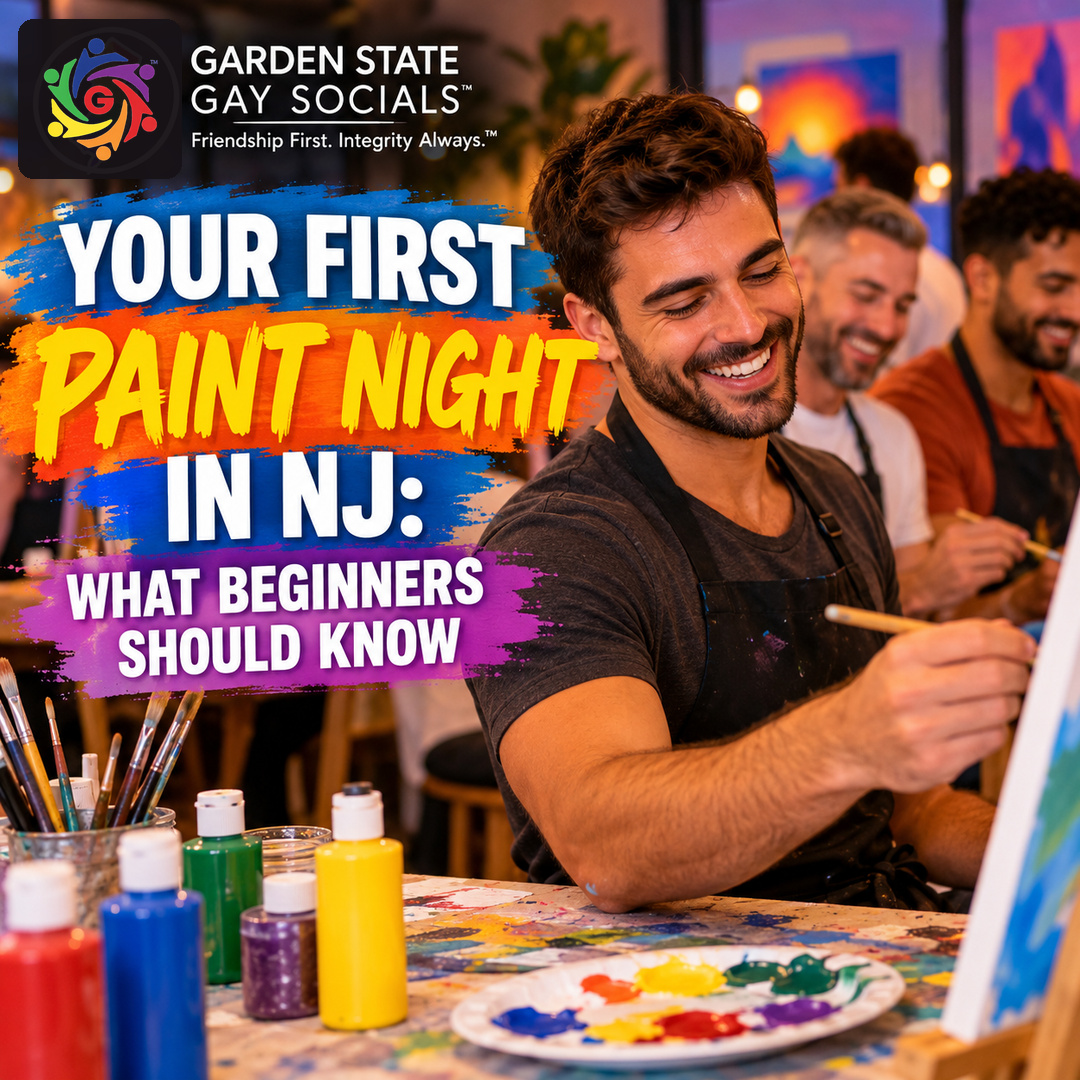
Your First Paint Night in NJ: What Beginners Should Know
You have probably seen photographs of people holding colorful paintings at the end of a creative evening. Everyone appears pleased with the finished result, and the experience looks like an enjoyable way to spend a few hours. Then a question comes to mind: What if you have absolutely no idea how to paint?
Perhaps your last experience with a paintbrush was in elementary school. Maybe you have never worked with acrylic paint, cannot draw a straight line, and would not know where to begin with a blank canvas. You might be curious about attending a painting event but hesitate because you assume everyone else will have more experience.
Fortunately, beginner paint nights are generally designed for people who want to explore painting rather than demonstrate advanced artistic ability.
For gay men looking for creative activities in New Jersey, a guided painting experience offers a practical way to try something unfamiliar, build a new skill, and enjoy an evening with others who share your interest.
At Garden State Gay Socials™, our philosophy is Friendship First. Integrity Always.™ We organize experiences that give gay men opportunities to participate in activities, discover new interests, and spend time together in a respectful environment.
Whether you are considering your first painting experience or simply wondering what a guided art session involves, this guide will help you prepare.
You will learn what materials are commonly used, how instruction works, what to wear, how to manage mistakes, what questions to ask before registering, and how to make the most of the evening.
Most importantly, you will discover that enjoying a creative activity does not require artistic perfection.
Why Try Painting When You Have Never Done It Before?
Trying an unfamiliar activity can be rewarding precisely because you do not already know everything about it.
Much of adult life involves responsibilities and routines we have practiced for years. We become comfortable with familiar tasks, established schedules, and activities that produce predictable results.
Creative experiences offer something different.
When you pick up a paintbrush for the first time, you enter an environment where learning is part of the experience. You may need to concentrate on an unfamiliar technique, make decisions about color, or experiment with a process that initially feels awkward.
That unfamiliarity can be interesting, not intimidating.
You might discover that you enjoy mixing colors. You may find satisfaction in watching an image develop gradually. Perhaps you will appreciate spending time on an activity that does not involve your phone, computer, or usual obligations.
You might even discover that you don't want to pursue painting regularly.
That is still useful information.
Trying something new doesn't necessarily mean developing a lifelong hobby. Sometimes, it is simply to expand your experiences and discover what you enjoy.
If you have been considering a new activity but repeatedly postponing it, our article about the plans we keep saying we will make explores why interesting ideas often remain on our calendars only in theory.
A paint night lets you turn curiosity into participation.
What Is a Guided Paint Night?
A guided paint night is an organized painting session in which participants create individual artwork with instruction from an artist or facilitator.
Unlike an extended art course, which might cover multiple techniques over several weeks, a paint night generally concentrates on a project that can be completed during one scheduled experience.
The instructor may demonstrate how to set up a background, apply color, create shapes, and add details.
Participants follow the process at their own workstations.
Depending on the format, everyone may work toward a similar image, or the instructor may encourage personal variations.
The atmosphere is usually less formal than an academic art class.
However, the exact structure depends on the studio, instructor, and event.
Some sessions emphasize careful instruction. Others provide more opportunities for experimentation and conversation.
Before registering, read the description to understand whether the activity is intended for beginners and whether a particular painting will be demonstrated.
A well-described event should help you understand what kind of experience you are purchasing.
Do You Need Artistic Talent?
No special artistic talent is generally required for a painting session advertised as suitable for beginners.
Painting involves techniques that can be demonstrated, practiced, and gradually improved.
You may learn how to select a brush, apply paint evenly, create a basic outline, or combine colors to achieve a particular effect.
Some participants will find these techniques easier than others.
That difference does not mean someone is more deserving of participating.
It simply reflects differences in previous experience, coordination, confidence, and personal preferences.
An introductory session should allow you to learn without assuming you already possess advanced skills.
It is also important to separate artistic ability from enjoyment.
You can enjoy cooking without becoming a professional chef.
You can enjoy hiking without being an experienced mountaineer.
Likewise, you can enjoy painting without producing professional artwork.
Your finished canvas is only one part of the experience.
The time you spend learning, experimenting, and participating matters, too.
How to Choose the Right Painting Experience
Not every painting activity is organized in the same way.
Before registering, look for a description that clearly explains the intended skill level.
If the event is advertised as beginner-friendly, that is a useful starting point.
Next, determine whether the session is guided or primarily independent.
A guided session may be preferable if you have never painted because the instructor provides a sequence of steps.
An independent painting session can offer greater creative freedom but may require participants to make more decisions without direct instruction.
Consider the duration.
If you are unfamiliar with painting, a session lasting several hours may be enjoyable, but you should be comfortable remaining at a workstation for much of that time.
Review what materials are included.
A class that provides the canvas, paint, brushes, and other supplies may be easier for beginners than one requiring separate purchases.
Finally, consider the overall atmosphere.
Some people enjoy a quiet instructional setting. Others prefer an organized group experience that combines creativity and social interaction.
Neither is universally better.
Choose the experience that matches your interests and expectations.
Browse upcoming Garden State Gay Socials activities to see what creative and other organized experiences are available.
Preparing Before the Event
A little preparation can make your first paint night more comfortable.
Start by reviewing your registration confirmation.
Confirm the date, location, arrival instructions, and any requirements the organizer communicated.
Do not rely solely on an advertisement or social media post if more recent information has been provided through the official registration process.
Check the venue's location in advance.
If you are unfamiliar with the area, review your travel route and allow sufficient time for parking.
Arriving in a rush can make an otherwise enjoyable experience feel stressful before it begins.
Consider whether you need to bring anything.
Many guided sessions provide painting supplies, but that should never be assumed without checking.
If food or beverages are part of the event, review the details before arriving.
If you have allergies, accessibility requirements, or questions about the activity, contact the organizer in advance.
It is easier to resolve practical concerns before the event than while the instructor is beginning a demonstration.
What Should You Wear to Paint Night?
Comfortable, practical clothing is usually best.
Painting can involve accidental drips, splashes, and contact with wet surfaces.
Even if you work carefully, a little paint may still reach your sleeves or clothing.
Choose an outfit you would not be overly concerned about staining.
Avoid loose sleeves that could brush against a canvas or water container.
Comfortable pants and shoes are sensible because you may spend a considerable amount of time seated or moving around a workstation.
Some studios provide aprons.
Others may expect participants to dress appropriately for the activity.
Check the event instructions rather than assuming protective clothing will be supplied.
If you tend to feel cold in indoor spaces, a light layer may be helpful.
The goal is not to look like an artist.
Wear something that lets you concentrate on the activity without worrying about your clothing.
Understanding the Painting Supplies
A typical beginner painting session may use a canvas, acrylic paint, brushes, water containers, and paper towels.
However, the materials depend on the particular project.
Guided painting experiences often use acrylic paint because it is versatile and generally dries faster than traditional oil paint.
An instructor may demonstrate how different brushes create different marks.
A wide brush can cover larger sections of the canvas.
A smaller brush may help with fine lines and details.
Brush shape also affects how paint is applied.
Flat brushes create broad strokes and edges, while rounded brushes work well for curves and smaller shapes.
You may also learn how to rinse brushes between colors.
This matters because leftover paint can change how the next color looks.
Too much water may dilute paint or make a stroke difficult to control.
Too little paint may create uneven coverage.
These details become easier to understand through demonstration and practice.
Do not worry about memorizing every technique beforehand.
A beginner experience is an opportunity to learn the basics as you go.
How Painting Instruction Usually Works
A guided painting project often begins with the largest elements of the image.
For example, an instructor might show you how to cover the background with a specific color.
Next, participants may add broad shapes that establish the composition.
Additional layers can create depth, contrast, or texture.
Smaller details usually come later.
This sequence helps participants avoid feeling overwhelmed by the completed painting.
A finished image may seem complicated when viewed as a whole.
However, each step can be much simpler.
Think of the process as assembling a project one component at a time.
You do not need to understand every future step before completing the current one.
Pay attention to the instructor's demonstrations.
If something is unclear, ask for clarification.
It is generally better to understand a technique before applying it than to rush ahead and correct it later.
What If You Cannot Keep Up?
Different participants work at different speeds.
Someone who has painted before may complete a stage quickly.
Another person may need additional time to understand how a brush behaves.
Neither situation is unusual.
If you begin falling behind, concentrate on the major elements of the painting.
Ask the instructor which steps are essential and which details can be simplified.
Do not spend excessive time adjusting a minor feature while the rest of the composition remains unfinished.
For example, if the project involves a landscape, completing the background and central shapes may be more important than perfecting one tiny branch.
You can return to details if time permits.
The objective is to make steady progress while enjoying the activity.
A paint night should not become a competition to finish first.
Learning to Work With Color
Color is one of the most enjoyable aspects of painting.
It can also confuse beginners.
A color that looks attractive on a palette may appear different when applied next to another shade.
Some colors create strong contrast.
Others blend more subtly.
An instructor may explain how to combine colors to achieve a particular effect.
You might learn how adding white changes a shade's appearance or how a darker color can create depth.
Pay attention to how colors interact rather than focusing exclusively on whether they match the demonstration.
A small variation may make your painting more interesting.
If you want to experiment, consider testing a color in a less noticeable area before applying it across a large section.
You can also ask the instructor whether a substitution will work with the overall design.
Creative freedom is enjoyable, but understanding the basic composition can help you make more deliberate choices.
Why Paint Layers Matter
A common beginner mistake is adding new details before the underlying paint has dried enough.
When wet colors touch, they may blend.
Sometimes that produces an attractive effect.
Other times, it can outline disappear or change a color unexpectedly.
The appropriate drying time depends on the paint, application thickness, and environmental conditions.
If an instructor recommends waiting before adding another layer, follow that guidance.
You may be able to work on a different section while the first area dries.
Avoid repeatedly touching the surface to check whether it is ready.
That can damage the paint or leave unwanted marks.
Learning to recognize when to continue and when to wait is part of the process.
Painting rewards attention and patience.
What Happens When You Make a Mistake?
Every beginner eventually produces a brushstroke that does not look the way it was intended.
Perhaps a line becomes too thick.
Maybe a shape is uneven.
You might accidentally mix colors that produce an unexpected shade.
The first response should not be panic.
Stop and examine what happened.
Ask whether the difference is genuinely a problem or simply a variation from the example.
If it needs correction, consult the instructor.
Depending on the materials, some areas can be adjusted after drying.
Other problems may require changing the surrounding composition.
Trying to fix everything immediately can sometimes make the result worse.
A painting isn't ruined just because one element looks different.
Adaptability is part of creativity.
You may discover that an unexpected detail becomes one of your favorite parts of the finished work.
Avoiding the Pressure to Be Perfect
Perfectionism can interfere with activities that should be enjoyable.
A participant may become so focused on reproducing the instructor's painting exactly that every variation feels like failure.
That mindset can make learning unnecessarily stressful.
Instead, establish a more useful goal.
You want to understand the basic process, participate in the activity, and create something that reflects your effort.
Your painting does not need to look identical to anyone else's.
Two people can follow the same instructions and produce different results because of individual choices and techniques.
That variation is part of the appeal.
When you notice yourself becoming overly critical, focus on the next manageable step.
Ask what the painting needs rather than whether it is perfect.
The experience often becomes more enjoyable when you allow yourself to learn without constant self-judgment.
Taking Breaks Without Losing Momentum
Painting requires concentration, but you don't always need continuous focus.
Depending on the format, there may be natural pauses between demonstrations or while layers dry.
Use those moments to relax your hands, look at your work from a little distance, or ask a question.
Stepping back can help you notice the overall composition.
A detail that looked enormous while you were working closely may appear much less significant from a normal viewing distance.
If refreshments are available, follow the studio's rules about keeping food and drinks away from painting materials.
Be careful not to confuse a water container used for brushes with a beverage.
Keep your workspace organized.
Simple habits can make the evening more comfortable and prevent avoidable accidents.
The Social Side of a Creative Activity
A guided paint night provides a shared experience without requiring conversation to fill every moment.
Participants can concentrate on their paintings while remaining open to friendly interaction.
You might ask someone whether he has painted before.
You could compliment a color choice or ask how he created a particular effect.
Someone else may start a conversation about the painting's subject.
These exchanges connect directly to the activity.
That can make conversation feel less forced.
Our article about how shared activities build gay friendships explores the broader value of spending time together through common experiences.
At a painting session, the practical advantage is simple: everyone has something to do.
A few minutes of quiet concentration are normal.
Conversation can resume naturally when participants reach a stopping point.
Respecting Different Comfort Levels
Not everyone enjoys the same amount of conversation during a creative activity.
Some participants like to talk while they work.
Others prefer to focus on the instructions and socialize during breaks.
Both preferences are reasonable.
If someone appears focused on a difficult section, allow him the space to complete it.
Avoid touching another participant's painting or moving supplies without permission.
Be considerate when commenting on artwork.
An observation meant as humor may discourage someone who is already uncertain about his abilities.
Encouragement is usually more constructive than unsolicited criticism.
You might genuinely admire a particular color combination or creative interpretation.
Share that appreciation without turning the moment into a comparison.
Garden State Gay Socials maintains a Code of Conduct that outlines expectations for respectful participation.
Those principles matter during creative experiences just as much as during any other community activity.
Can You Attend Without Bringing Someone?
For events that allow individual registration, attending on your own is a perfectly reasonable option.
You do not need to find someone who shares every interest before exploring a new activity.
In fact, waiting for another person's schedule to align with yours can mean repeatedly postponing experiences you would otherwise enjoy.
A guided session provides structure from the beginning.
You can check in, find your workspace, and focus on the instructor's demonstration.
You don't need to arrive with an elaborate introduction or keep making conversation.
If you enjoy talking with someone nearby, you can do so naturally.
If you prefer to concentrate initially, that is also reasonable.
The important thing is to evaluate the experience according to your own interests rather than assuming you must arrive with an established group.
For a broader discussion of participation, our article on attending gay men's social events alone in New Jersey explores this subject in more detail.
What to Ask Before Registering
Before purchasing a ticket for any painting experience, confirm the essential details.
First, determine whether the class is suitable for beginners.
Second, verify whether painting supplies are included.
Third, check the scheduled duration and whether participants are expected to complete a particular project.
Ask whether the venue has any clothing recommendations or restrictions.
If refreshments are advertised, review exactly what is included.
Participants with dietary restrictions should confirm whether suitable options are available rather than assuming substitutions can be provided.
Accessibility questions should also be addressed before registration.
If you need a particular accommodation, contact the organizer to determine whether it can be arranged.
Finally, review the applicable cancellation and refund terms.
Garden State Gay Socials provides a refund policy for visitors who want to understand its published conditions.
These practical checks help prevent misunderstandings and set realistic expectations.
How to Transport Your Painting
One satisfying part of a painting experience is leaving with something you created.
However, freshly applied paint may still require careful handling.
Even when a surface appears dry, thicker areas can remain vulnerable to contact.
Before leaving, ask the instructor how the painting should be transported.
Some studios may provide protective materials.
Others may recommend keeping the canvas upright and avoiding contact with the painted surface.
Do not place a wet painting face down on a car seat.
Avoid stacking bags or other belongings against the artwork.
Once you arrive home, place the painting somewhere it can continue drying without being disturbed.
If you plan to frame it, ask whether additional drying time is recommended.
Your finished painting does not have to be a masterpiece to deserve a place in your home.
It can simply remind you of an enjoyable evening and a new experience.
Should You Continue Painting After Your First Class?
You may discover that you enjoy painting enough to try it again.
If so, there are several ways to continue.
You could attend another guided class with a different subject or technique.
You might purchase a small collection of beginner supplies and experiment at home.
You could explore introductory tutorials or a more structured art course.
There is no requirement to make an immediate commitment.
Try to identify which parts of the experience you enjoyed.
Did you appreciate learning a new technique?
Did you like experimenting with colors?
Was the structured instruction helpful?
Or did you enjoy working on a creative project for an evening?
Your answers can guide your next decision.
You may also find another hands-on activity, such as pottery or a different creative workshop, more appealing.
Trying one activity can introduce you to several others.
Choosing Activities That Fit Your Interests
A fulfilling social calendar does not need to revolve around one type of experience.
Some people enjoy painting and other creative workshops.
Others prefer outdoor activities, cultural attractions, dining experiences, or seasonal outings.
Many enjoy a combination.
The important thing is to choose activities that genuinely interest you.
You are more likely to appreciate an experience when you attend because the subject appeals to you rather than because you feel obligated to participate.
Our article about things to do for gay men in New Jersey explores the variety of experiences available beyond a single activity.
A paint night is one possibility within a much broader range of interests.
If you discover that painting isn't your favorite activity, that doesn't mean you should stop exploring.
It simply means you have learned something about your preferences.
Why Trying Something Once Is Not Always Enough
A first experience can feel different from a second or third attempt.
During your first painting session, much of your attention may be devoted to understanding the materials and instructions.
If you attend another session, some of those details may already feel familiar.
You might become more comfortable choosing colors or handling a brush.
You may also recognize people from a previous activity.
That familiarity can make an environment feel less new.
Our article on why familiar faces improve social events examines the role of repeated encounters in community experiences.
However, there is no obligation to repeat an activity simply because you tried it once.
If painting interests you, consider another session.
If not, explore something else.
The goal is to discover enjoyable experiences, not create another obligation.
What Makes a Successful First Paint Night?
A successful experience does not require a perfect painting.
It begins with choosing an activity that interests you and preparing appropriately.
You understand the basic format, know what to bring, and arrive with reasonable expectations.
During the session, you follow instructions, ask questions when needed, and allow yourself to make mistakes.
You respect the instructor, the venue, and other participants.
You take time to appreciate the process rather than evaluating every brushstroke as a success or failure.
At the end, you may have a painting you are proud to display.
You may also have discovered a technique you want to practice again.
Perhaps you enjoyed the conversation, the creativity, or simply doing something outside your ordinary routine.
All of those outcomes can make the experience worthwhile.
The important measure is whether you found value in participating.
Explore Creative Experiences With Garden State Gay Socials™
Garden State Gay Socials™ organizes activities for gay men who want opportunities to participate in experiences throughout New Jersey and the surrounding region.
Creative workshops are one way to explore new interests, but they are only part of what a varied social calendar can offer.
If a guided paint night sounds appealing, explore the organization's current schedule.
You can also learn more about Garden State Gay Socials membership benefits and discover the broader community.
When you are ready to see what is coming up, visit the permanent Garden State Gay Socials Events page.
Event schedules change, but the opportunity to discover a new interest doesn't depend on any one date.
Whether your next experience involves painting, exploring a destination, enjoying a meal, or participating in another organized activity, choose something that genuinely interests you.
You do not need to be an artist to enjoy a paint night.
You just need to be willing to try it.
Garden State Gay Socials™
Friendship First. Integrity Always. ™
Leave A Comment
Please login to add a comment!
Comments (0)