Why Friendship Grows Slowly for Gay Men
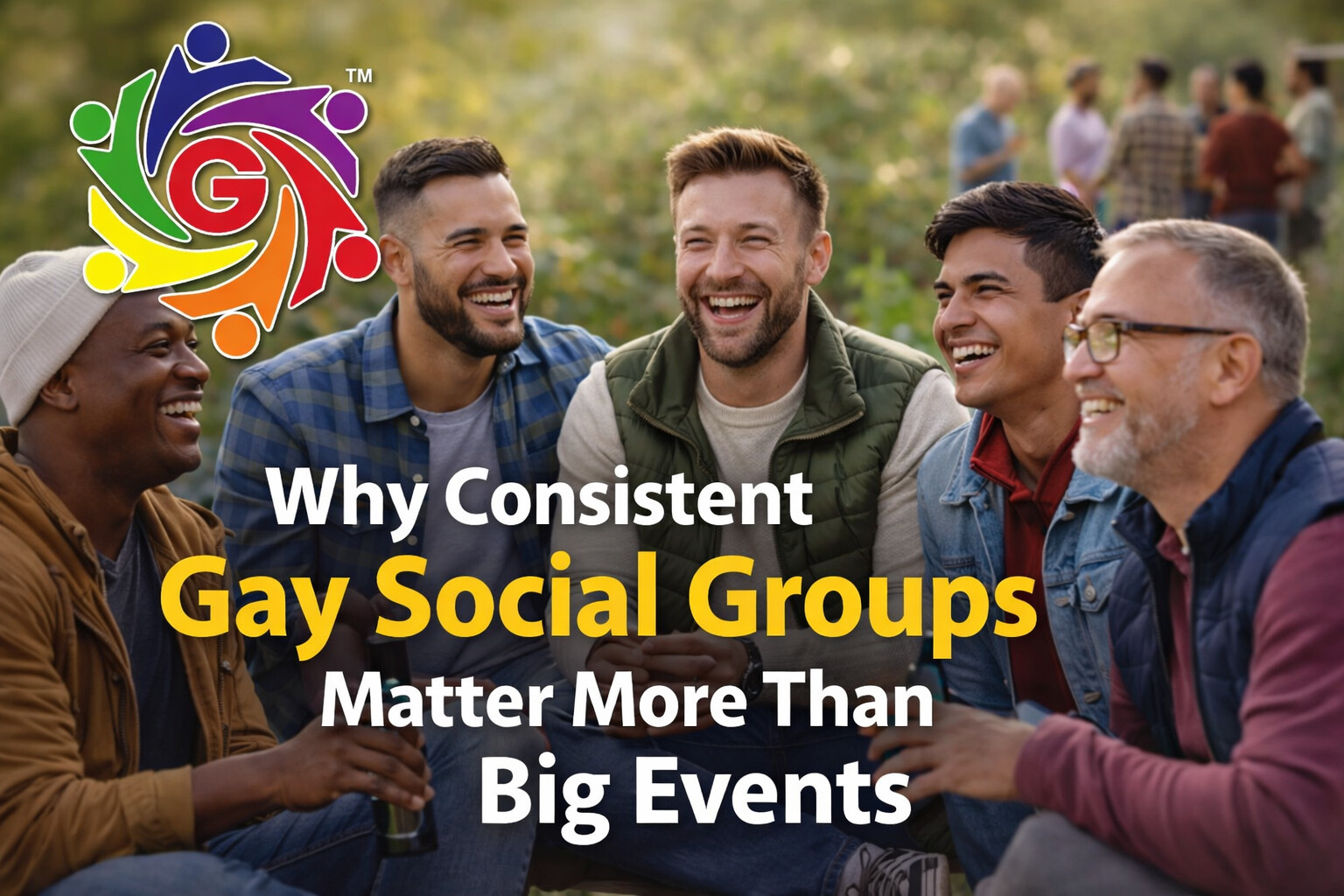
Most gay men know the feeling. You see a big event advertised. The photos look fun. The description promises energy, connection, maybe even friendship. You imagine yourself there—talking, laughing, finally feeling part of something bigger.
So you go.
For a few hours, it feels good. There are people everywhere. Music, conversation, movement. You meet a handful of men. You exchange names. Maybe a number or a follow on social media. You leave thinking, That was nice.
Then the next day comes.
Nothing changes.
You’re still scrolling. Still wondering who you actually belong with. Still feeling like connection is always just out of reach.
This experience is incredibly common, and it has very little to do with effort, personality, or social skill. It has everything to do with how community is built.
Big events create moments.
Consistent gay social groups create momentum.
And momentum is what turns strangers into friends.
Big Events Create Energy — Not Continuity
There’s nothing wrong with large-scale gay events. They have their place. They celebrate visibility. They remind people they’re not alone. They can be joyful and affirming.
But structurally, big events are designed for impact, not continuity.
At large events:
-
People rotate constantly
-
Conversations are short by necessity
-
Social pressure is high
-
Everyone is new to everyone else
-
Follow-up is uncertain and rare
Even when a big event is enjoyable, it resets immediately afterward. There is no built-in mechanism for familiarity to develop. Everyone disperses, and the social thread breaks.
Community cannot survive on resets alone.
Why Gay Men Feel This More Deeply
Gay men often arrive at adulthood without a strong blueprint for long-term male friendship. Many spent formative years guarded, selective, or isolated—carefully choosing when and where it was safe to be themselves.
That history shapes adult social behavior in subtle ways:
-
Hesitation to trust new spaces
-
Fear of being judged or excluded
-
Pressure to present a “best version”
-
Emotional fatigue around starting over socially
In large, unfamiliar environments, these instincts can activate automatically. Even confident men can feel the quiet stress of needing to perform, impress, or prove they belong.
Consistency softens those instincts.
When a group meets regularly, the nervous system learns something important: I’ve been here before. I know this place. I’m safe here.
That sense of safety is the foundation of real connection.
Familiarity Is the Gateway to Trust
Human beings bond through repetition. This isn’t opinion—it’s psychology.
Familiarity:
-
Reduces anxiety
-
Builds comfort
-
Encourages openness
-
Lowers social defenses
When you attend a consistent gay social group, small changes happen over time:
-
Faces become recognizable
-
Names start to stick
-
Conversations resume instead of restart
-
Social tension fades
You don’t have to explain yourself from scratch every time. You don’t have to wonder if you’ll be accepted. You already know the tone, the pace, and the general vibe.
That predictability is powerful.
It allows people to relax—and relaxed people connect more deeply.
The Power of Seeing the Same People Again
The first time you attend a group, you’re observing.
The second time, you recognize a few faces.
The third time, you start remembering names.
The fourth time, conversations pick up naturally.
This progression is not accidental. It’s how relationships form in real life.
Repeated exposure creates:
-
Shared context
-
Ongoing conversation
-
Inside references
-
Emotional continuity
Suddenly, you’re not just attending an event—you’re part of something ongoing.
That shift changes how you show up.
Why Consistency Reduces Social Anxiety
Many gay men don’t dislike socializing. They dislike uncertainty.
Before attending something new, the mind fills the gaps:
-
Will I fit in?
-
Will I feel awkward?
-
Will everyone already know each other?
-
Will I regret coming?
Consistent social groups reduce these unknowns dramatically.
You already know:
-
What kind of people attend
-
How conversations usually feel
-
That you won’t be the only quiet one
-
That showing up won’t be a gamble
This predictability lowers anxiety, which makes participation easier.
When anxiety drops, authenticity rises.
Community Is Built Between Events
One of the most misunderstood aspects of community is where it actually forms.
It doesn’t form in the loudest moment.
It doesn’t form at the peak of excitement.
Community forms between events.
It forms when:
-
Someone remembers something you shared last time
-
A conversation continues instead of restarting
-
Your absence is noticed
-
Your presence feels expected
These moments require continuity. They cannot exist in one-off environments.
Big events end.
Consistent groups continue.
Why This Matters More as Gay Men Age
As gay men move through their 30s, 40s, and beyond, priorities shift. The thrill of novelty often gives way to the desire for stability and depth.
Many men reach a point where they’re tired of:
-
Constantly introducing themselves
-
Surface-level interaction
-
Social spaces that feel performative
-
Feeling invisible in crowds
What they want instead is:
-
Familiar faces
-
Ongoing connection
-
A place where they don’t have to start over
-
A sense of belonging that grows over time
Consistent gay social groups meet this need naturally, without forcing it.
Local Consistency Builds Real Roots
In regions like New Jersey, New York, and Pennsylvania, gay men are often spread across towns, counties, and cities. Commutes are long. Schedules are full. Social circles can become fragmented.
A consistent regional group provides:
-
A reliable home base
-
Repeatable opportunities to connect
-
A reason to stay socially engaged locally
-
Relationships that are realistic to maintain
You don’t need to reinvent your life. You just need a place where showing up regularly matters.
The Difference Between Being Welcomed and Being Known
Many spaces are welcoming. Few allow you to be known.
Being known means:
-
Someone remembers your name
-
Someone asks how your week went
-
Someone checks in when you miss a meeting
-
Someone expects to see you again
That kind of recognition doesn’t happen in one night. It happens through repeated contact and shared experience.
Consistency makes being known possible.
Consistency Creates Culture
Culture doesn’t come from mission statements. It comes from repetition.
When a group meets consistently:
-
Expectations form naturally
-
Respect becomes the norm
-
Inclusion becomes real, not performative
-
New members are absorbed instead of isolated
Over time, the group develops its own rhythm—one that feels human, not transactional.
This is especially important in gay men’s spaces, where many have experienced exclusion even within the community.
Friendship First Changes Everything
When friendship comes first:
-
Pressure disappears
-
Competition fades
-
People stop performing
-
Authenticity increases
Men no longer feel the need to impress. They feel permission to simply be present.
Ironically, removing pressure often makes connection easier—not harder.
Consistent groups create this environment because they don’t rely on one moment to succeed. They allow relationships to unfold at their own pace.
What Consistent Groups Offer That Apps Never Can
Apps are built for speed and novelty. They reset constantly. Conversations disappear. People are reduced to profiles.
Consistent social groups offer something fundamentally different:
-
Presence instead of profiles
-
Memory instead of swipes
-
Shared experience instead of endless choice
-
Continuity instead of churn
For many gay men, this difference isn’t just refreshing—it’s life-changing.
Community Is a Practice, Not an Event
Community isn’t something you attend once and check off a list.
It’s something you practice:
-
By showing up
-
By returning
-
By being seen
-
By letting yourself belong
Big events can be fun. They can be energizing. They can be part of a social life.
But for gay men seeking real friendship, stability, and belonging, consistency is what makes community possible.
Moments fade.
Community stays.
Leave A Comment
Please login to add a comment!
Comments (0)