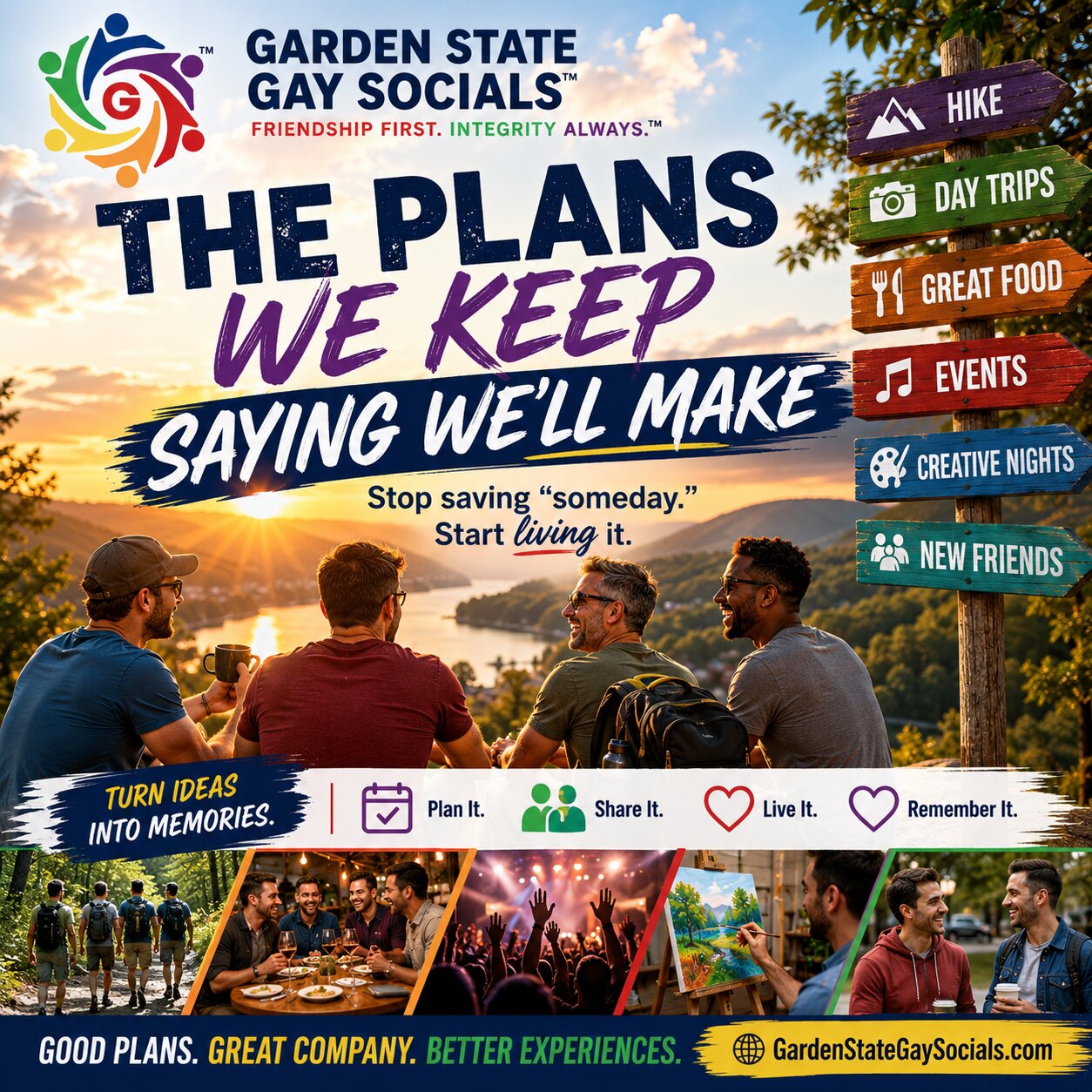
The Plans We Keep Saying We’ll Make
A particular kind of plan lives comfortably in the future.
We should try that restaurant sometime. We should take a day trip when the weather gets nicer. We should finally go hiking. We should catch that exhibit before it closes. We should get everyone together for dinner. We should spend a Saturday somewhere we have never been.
The enthusiasm is usually genuine. Nobody is trying to avoid the experience, and nobody necessarily intends to let the idea disappear. Yet “sometime” has an extraordinary ability to remain permanently out of reach. A few weeks pass, calendars fill, another season arrives, and eventually the restaurant closes, the exhibit ends, the weather changes, or somebody mentions the idea again as though the original conversation happened yesterday.
Modern life has made planning extraordinarily easy while somehow making plans increasingly difficult. We carry calendars everywhere, communicate instantly, purchase tickets in seconds, and can discover hundreds of things happening within driving distance before breakfast. What we seem to have lost is some of the spontaneity that once turned an interesting idea into an actual Saturday.
For anyone trying to build a richer social life, that gap between wanting to do something and actually doing it may matter more than we realize.
“Sometime” Is Not Really a Date
There is nothing wrong with saying we should do something sometime. It is often the first indication that two people have discovered a shared interest, and plenty of wonderful experiences begin exactly that way.
The problem is what happens next.
Nobody chooses Saturday. Nobody buys the tickets. Nobody makes the reservation. Nobody sends the message that turns an appealing idea into a commitment. The plan remains pleasantly theoretical because theoretical plans require no coordination, no decision, and, perhaps most importantly, no risk that somebody else might say no.
Adults become remarkably skilled at discussing things they would enjoy doing while waiting for circumstances to make those things convenient. Unfortunately, convenience is not particularly reliable.
There will always be another obligation, another project, another expense, another reason to postpone something enjoyable until a less complicated week. The fantasy is that we'll eventually reach a stretch of life when everything is handled, everyone is available, and the calendar opens beautifully in front of us.
Most of us know how often that happens.
The Calendar Did Not Become Full Overnight
One of the strange things about adulthood is how easily obligations claim time before enjoyment does.
Work meetings get scheduled. Appointments get scheduled. Home repairs get scheduled. Family responsibilities get scheduled. Deadlines receive dates, reminders, and notifications. We organize the things we must do with impressive precision while leaving many of the things we would actually like to do floating somewhere in the future.
That does not mean responsibilities should be ignored. It means enjoyment frequently receives whatever time survives after everything else has taken its share.
Weekends are especially vulnerable. A Saturday that looked completely open on Monday can quietly accumulate errands, household projects, and unfinished work until Sunday evening arrives and the weekend feels as though it never really began.
There is an important difference between using a weekend to rest because that is genuinely what you need and allowing every weekend to default into the same routine because nothing else ever made it onto the calendar.
The first is restorative.
The second can eventually make months feel strangely interchangeable.
Sometimes the activity is not the problem at all. The problem is assembling the people.
You know exactly what you would like to do. Still, one friend is working, another already has plans, someone else lives too far away, and the person who enthusiastically said yes three weeks ago has suddenly disappeared into a complicated schedule of his own.
So the entire idea gets postponed.
This is one of the less discussed challenges of adult friendship. When we were younger, social groups often existed before the plan did. People were already together at school, college, work, or in a neighborhood, and someone suggested what everyone should do next.
Later in life, we often attempt the process in reverse. We find something interesting and then begin assembling the cast.
That can make even a simple afternoon feel like event production.
Another possibility, however: sometimes you do not need to create the group yourself.
Community organizations, activity groups, cultural organizations, recreational clubs, and social communities already place experiences on calendars. The restaurant has been chosen. The trail has been selected. The tickets exist. The date is real.
Instead of convincing six people to become available on the same afternoon, the decision becomes considerably simpler.
Do I want to go?
An Invitation Is More Valuable Than It Looks
Invitations are easy to underestimate because most of them seem ordinary.
Would you like to grab breakfast?
Want to come hiking Saturday?
A few of us are going to a festival.
We're trying this place next week.
There is nothing dramatic about any of those sentences, yet they can alter the direction of a weekend and sometimes considerably more than that.
An invitation tells someone that his presence was considered. It creates an opportunity to step outside a routine without having to invent the entire experience himself. For someone whose social circle has changed, who is new to an area, or who wants to meet more people, that invitation can carry considerably more weight than the person extending it realizes.
The reverse is also true.
We sometimes hesitate to invite people because we assume they are busy, partnered, already surrounded by friends, or unlikely to be interested. In doing so, we decide for them before they ever get the chance to decide for themselves.
Not every invitation will be accepted, and it does not need to be.
A social life grows partly because people continue creating possibilities.
New Jersey Is Full of Plans Waiting to Become Real
One advantage of living in New Jersey is that running out of possibilities takes considerable effort.
A relatively short drive can change the character of an entire day. North Jersey offers trails, lakes, historic communities, restaurants, gardens and cultural attractions. Head toward the shore and the experience changes completely. Small downtowns offer places worth exploring without requiring an elaborate itinerary. At the same time, museums, theaters, seasonal festivals, farms, sporting events and creative experiences continually add new reasons to leave familiar routines behind.
Then there are New York and Pennsylvania, both close enough to expand the possibilities without necessarily turning an outing into a vacation.
The problem is rarely finding something to do.
The problem is deciding that this is the weekend you are actually going to do it.
We save articles. We bookmark restaurants. We send friends videos of places that look interesting. We maintain mental lists of towns we have never explored and attractions we somehow keep passing on the highway.
Eventually, one of those saved ideas needs a date.
A Good Social Life Does Not Need to Be Spectacular
Social media has not done us many favors when it comes to expectations.
Scroll long enough and everybody else's weekend appears cinematic. Someone is traveling. Someone is attending an enormous event. Someone has found the perfect restaurant table beneath perfect lighting with a group of apparently perfect friends.
Ordinary Saturday afternoon rarely makes the highlight reel.
Yet ordinary experiences are where much of friendship actually lives.
A two-hour breakfast can matter more than an elaborate party. An easy hike can produce a better conversation than an expensive evening out. A day trip that contains nothing particularly extraordinary can become memorable because of who was there.
A satisfying social life is not necessarily constructed from spectacular experiences. More often, it develops through enough ordinary experiences that people begin accumulating a history together.
The restaurant becomes that restaurant we went to.
The trail becomes that day we got completely turned around.
The painting becomes that thing nobody can believe you actually hung on the wall.
The experience acquires meaning because it becomes part of a shared story.
Saying Yes Has Its Own Momentum
The hardest part of trying something new is often the decision before it.
Once the reservation is made or the ticket is purchased, the experience becomes real. It occupies space on the calendar, and everything else begins arranging itself around it rather than the other way around.
That small shift matters.
People who regularly have interesting things on their calendars are not necessarily living less complicated lives than everyone else. They may simply be protecting some time for experiences before routine consumes it.
One good Saturday can also create momentum for another. You hear about a restaurant during lunch. Someone mentions a trail while hiking. Someone mentions a trail while hiking. A guy you met at one event appears at another.
Suddenly, plans are no longer isolated events. They begin generating other plans.
That is how a social life can grow without feeling as though you sat down one morning and decided to construct one.
Going Alone Does Not Mean Staying Alone
Of course, another reason many plans never happen is that nobody else is available, and going alone feels uncomfortable.
That reaction is understandable. There is security in arriving somewhere with someone you already know, particularly when the destination involves a group of unfamiliar people.
But waiting until you have someone to accompany you can create an impossible loop. You want to meet more people, but you don't attend because you don't already know someone who will go with you.
At some point, the circle has to break.
Attending alone does not require becoming fearless or extraordinarily outgoing. It simply requires accepting a few minutes of uncertainty at the beginning of an experience.
You can arrive without knowing anybody and leave knowing one name.
The next time, that one name may be enough to make the room feel different.
There is a tremendous difference between being alone and being willing to arrive alone.
Friendship Needs Something to Happen
Friendship is often discussed as though conversation alone creates it.
Conversation matters, but friendship also needs material.
People need things to remember together. They need experiences that produce jokes, opinions, discoveries, surprises, and the small moments that gradually reveal personality.
This is one reason shared activities can be such effective social environments. Nobody has to carry the entire interaction because something is happening around them.
A hike keeps moving. A creative activity gives everyone something to work on. A day trip continually changes the surroundings. A meal naturally moves through courses. A festival provides endless distractions and conversation starters.
The activity gives friendship something to work with.
Over time, the relationship can move beyond the activity itself, but having a reason to gather makes the beginning considerably easier.
Stop Waiting for Everybody
There is a temptation to believe an experience becomes worthwhile only when exactly the right people can attend.
That can keep a surprising number of experiences from happening.
If eight people are invited and four can come, perhaps four is enough. If the person you normally travel with is unavailable, perhaps somebody else would enjoy going. If nobody you know wants to attend something that genuinely interests you, perhaps that is precisely the experience worth trying alone.
Not every plan needs unanimous approval.
In fact, expanding a social life often requires allowing different people to occupy different parts of it. The friend who loves hiking may not be the friend who wants to see a musical. Someone who enjoys museums may have absolutely no interest in bowling. Another person may be the perfect companion for a long day trip but completely uninterested in an early breakfast.
That variety is healthy.
One person doesn't need to be your entire social world, and one group doesn't need to satisfy every interest.
Community Makes “Someday” Easier to Escape
One reason organized communities can become valuable is that they create something adults often struggle to create for themselves: a next time.
There is another breakfast.
Another outing.
Another creative experience.
Another place to explore.
You do not need to coordinate everyone's schedule from scratch because something is already happening. You can join when an experience interests you and let familiarity build over time.
At Garden State Gay Socials, that is one of the ideas behind creating different kinds of experiences for gay men throughout New Jersey and the surrounding region. Not everyone wants the same Saturday, and they should not have to.
Some men want to be outside. Others would happily trade a trail for a restaurant. Someone may love a day trip, while another would rather spend an evening painting, bowling, exploring a seasonal attraction, or simply talking over breakfast.
The individual activity changes.
The opportunity underneath it remains the same: people need reasons to spend time together before friendship has a chance to become anything more.
That is why our philosophy remains Friendship First. Integrity Always.™
The Best Time May Be the Time You Actually Choose
There will probably never be a weekend when every obligation disappears, every friend is available, the weather behaves perfectly, traffic vanishes, and nothing unexpected happens.
Waiting for that weekend is an excellent way to keep waiting.
Perhaps the restaurant you have been talking about does not need another discussion. Perhaps the trail does not need to remain bookmarked. Perhaps the day trip does not need to wait until next season, and perhaps the event you have considered attending three times deserves a fourth look followed by an actual registration.
A meaningful social life isn't built entirely on major decisions.
Sometimes it begins with something much smaller: putting a date beside an idea.
Because eventually, “we should do that sometime” has to become “how about Saturday?”
And Saturday has a much better chance of becoming a memory.
Friendship First. Integrity Always. ™
Visit our website to explore upcoming Garden State Gay Socials events, activities, day trips, hikes, creative experiences, and other opportunities to turn the plans you keep talking about into something you actually experience.
Subscribe to our free bi-monthly newsletter, Guys Gay Spectrum™, for upcoming experiences, community news, and new stories from Garden State Gay Socials. Reach out to us today if you have questions.
Leave A Comment
Please login to add a comment!
Comments (0)