Gay Men Events NJ to Meet People Without Apps
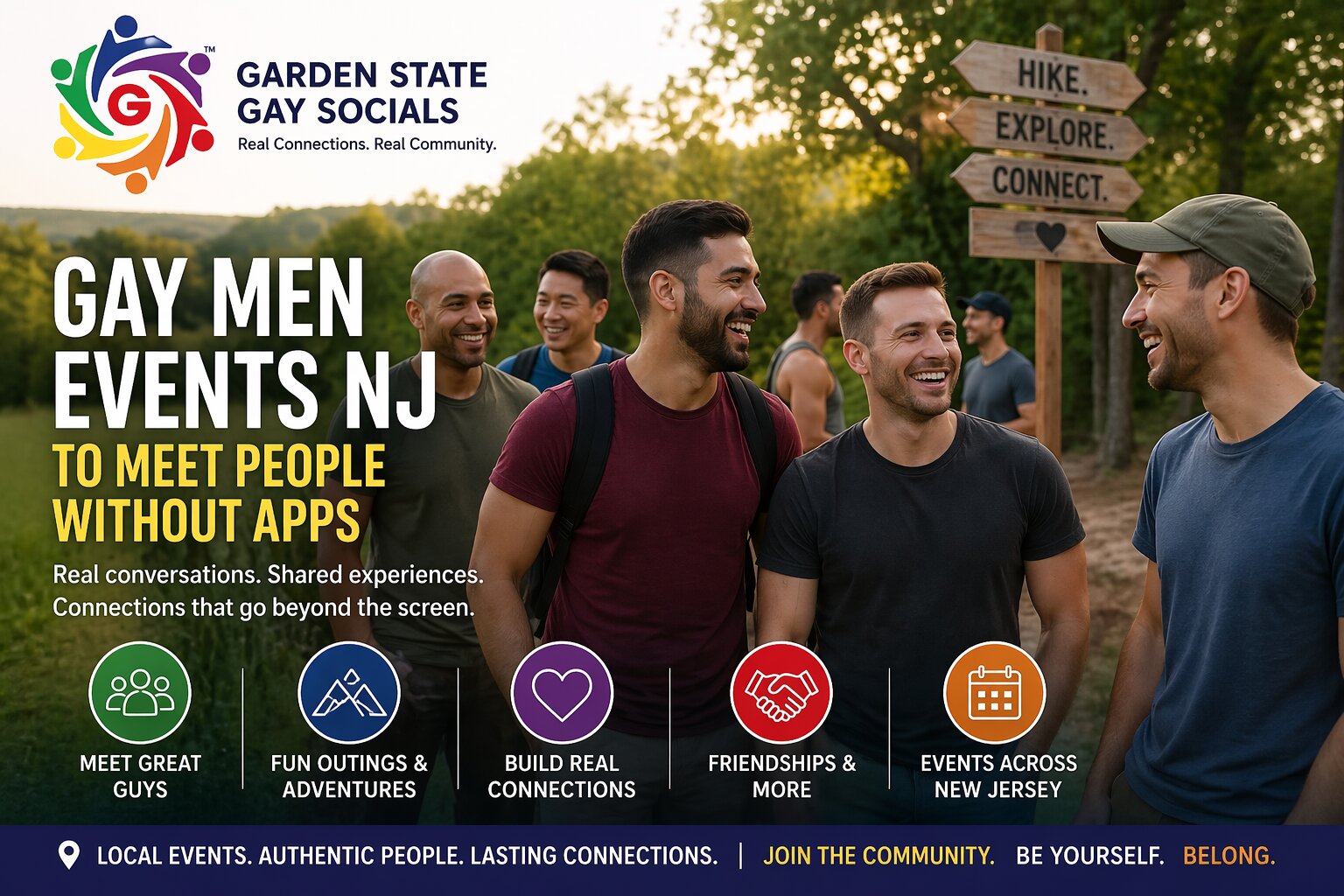
Gay Men Events NJ to Meet People Without Apps
If you have spent any real time trying to meet people through apps, you have probably noticed a pattern that is hard to ignore. Conversations begin quickly, often feel promising for a brief moment, and then fade out just as quickly, leading nowhere. Even when there is initial interest, it rarely develops into something that continues beyond a few exchanges. Over time, what once felt convenient can start to feel repetitive, and eventually, it can feel like you are putting in effort without getting anything meaningful in return.
This is exactly why more people are beginning to look beyond apps and toward something that feels more real. The goal is no longer to meet people, but to meet them in a way that allows something to develop naturally. That shift is what makes the difference, and it is why in-person environments, when structured correctly, are becoming more valuable again.
The key is not simply showing up somewhere in person. It is choosing the right kind of environment. Not all events are built the same way, and not all of them create the conditions needed for connection. Once you begin to understand what actually works, it becomes much easier to find experiences that feel different from what you may have been used to.
One of the main reasons apps tend to fall short is that they remove context. You are interacting with someone without any shared environment, without any natural pacing, and without the subtle cues that come from being physically present. Everything is condensed into short messages, and those messages often lack the depth to build anything meaningful. Without tone, presence, and shared experience, conversations tend to stay at the surface level.
In contrast, meeting people in person introduces elements that apps cannot replicate. There is shared space, shared time, and a shared experience that naturally shape how interactions unfold. Conversations develop at a more natural pace, and you can read body language, toshared experiencene, and energy in a way that is impossible through text alone. This creates a completely different dynamic, one that allows connection to form more organically.
However, simply being in person is not enough. Many people step away from apps only to walk into environments that are just as ineffective in a different way. Large, crowded events with constant movement often recreate the same problem. You may meet more people, but the interactions remain short, surface-level, and disconnected. The environment does not allow anything to build, and the experience ends up feeling similar to what you were trying to move away from.
This is why the structure of the event matters more than the event itself. Smaller, more intentional environments create a completely different experience. When the group size is limited, conversations can last longer. There is less pressure to move quickly, and people are more likely to stay present in the interaction. Instead of trying to meet as many people as possible, you can actually get to know a few people in a meaningful way.
Smaller groups also reduce the sense of competition that often exists in larger settings. When there are too many people, attention becomes fragmented, and interactions can feel transactional. In a smaller setting, the dynamic shifts. People are more relaxed, more approachable, and more open to conversation. This creates an environment where interaction feels natural rather than forced.
Another important element is the shared experience. Events that rely entirely on open conversation can create pressure, especially for those who are not naturally inclined to initiate interaction. When an activity is involved, such as a hike, a day trip, or another structured outing, the dynamic changes. The activity provides a natural starting point for conversation, removing the need to create interaction from scratch.
Shared experiences also create continuity. When people go through something together, even something simple, it gives them a reference point. Conversations can build on that shared moment, making it easier to reconnect and continue interacting. This is one of the key differences between environments that feel temporary and those that lead to something more lasting.
The pace of the environment also plays a significant role. In fast-paced settings, conversations tend to remain brief because there is always something else happening. People move quickly from one interaction to another, leaving little time to settle into a meaningful exchange. Slower, more relaxed environments allow conversations to develop naturally. There is no urgency to move on, which makes it easier to go beyond introductions.
One of the biggest concerns people have when stepping away from apps is the idea of showing up alone. This hesitation is completely normal and is one of the main reasons people avoid attending events in the first place. The right kind of event actually removes this barrier. When an environment is designed with the expectation that people will arrive on their own, the dynamic changes entirely.
There is a shared understanding among attendees, which reduces the awkwardness that can come with entering a new space alone. People are more open to interaction because they know others are in the same position. This creates a natural starting point for conversation and makes the experience more approachable.
Another advantage of in-person environments is the ability to build familiarity over time. Unlike apps, where interactions are often isolated, attending the right events can lead to seeing the same people more than once. This repetition is important because it allows connections to develop gradually rather than being forced all at once.
Familiarity reduces social friction. It becomes easier to start conversations, continue them, and move beyond the initial stage of getting to know someone. This is one of the key reasons why environments that encourage repeated interaction tend to produce stronger connections.
It is also important to understand that not every event is designed for the same purpose. Some environments are built for high energy and quick interaction, while others are designed for comfort and continuity. If your goal is to meet people in a way that actually leads somewhere, it becomes important to choose environments that align with that goal.
Instead of focusing on how many people will be there, it is more useful to examine how the event is structured. Is it designed to encourage meaningful conversation, or does it rely on constant movement? Is there a shared experience that naturally brings people together, or is the interaction entirely unstructured? Will there be an opportunity to reconnect with the same people, or is it a one-time interaction with no continuation?
These questions can help you evaluate whether an event is likely to provide a different experience from what you have encountered before. They shift your focus from quantity to quality, which is where real change happens.
Another factor often overlooked is the role of comfort in social environments. When people feel comfortable, they engage differently. They are more open, more relaxed, and more willing to participate in conversation. When an environment feels forced or high-pressure, people tend to hold back, even if they are interested in connecting.
Comfort is influenced by multiple factors, including group size, pacing, and the event's overall tone. Smaller groups, slower pacing, and a relaxed atmosphere all contribute to a setting where people feel at ease. This is where conversations begin to move beyond surface level and where connection starts to form.
As more people step away from apps, there is growing awareness that the environment itself matters. It is not just about being present, but about being present in the right place. When the structure supports connection, everything else becomes easier. Conversations feel more natural, interactions feel more meaningful, and the overall experience becomes more enjoyable.
This shift is not about going backward or rejecting technology. It is about recognizing that connection requires more than just access. It requires time, presence, and the right conditions. When those elements are in place, the experience changes in a way that apps cannot replicate.
For those looking to meeevents in New Jerseywhy gay events feel repetitivet people in New Jersey in a way that feels more real and less forced, the focus needs to be on environments that prioritize these elements. Smaller groups, shared experiences, and a relaxed pace all contribute to a setting where interaction can naturally evolve into something more.
If you are looking for events in New Jersey that are intentionally built around these principles, you can explore them here: https://gardenstategaysocials.com/page/gay-events-new-jersey.
The difference between meeting people and actually connecting with them often comes down to where and how those interactions take place. When you move away from environments that prioritize speed and volume toward those that emphasize comfort and continuity, the experience changes in meaningful ways.
Over time, this approach leads to stronger interactions, more consistent engagement, and a greater sense of connection. Instead of repeating the same patterns, you begin to build something that carries forward. That is ultimately what makes the shift away from apps worthwhile.
Leave A Comment
Please login to add a comment!
Comments (0)