Beyond Acceptance: Why Gay Men Need Community in NJ
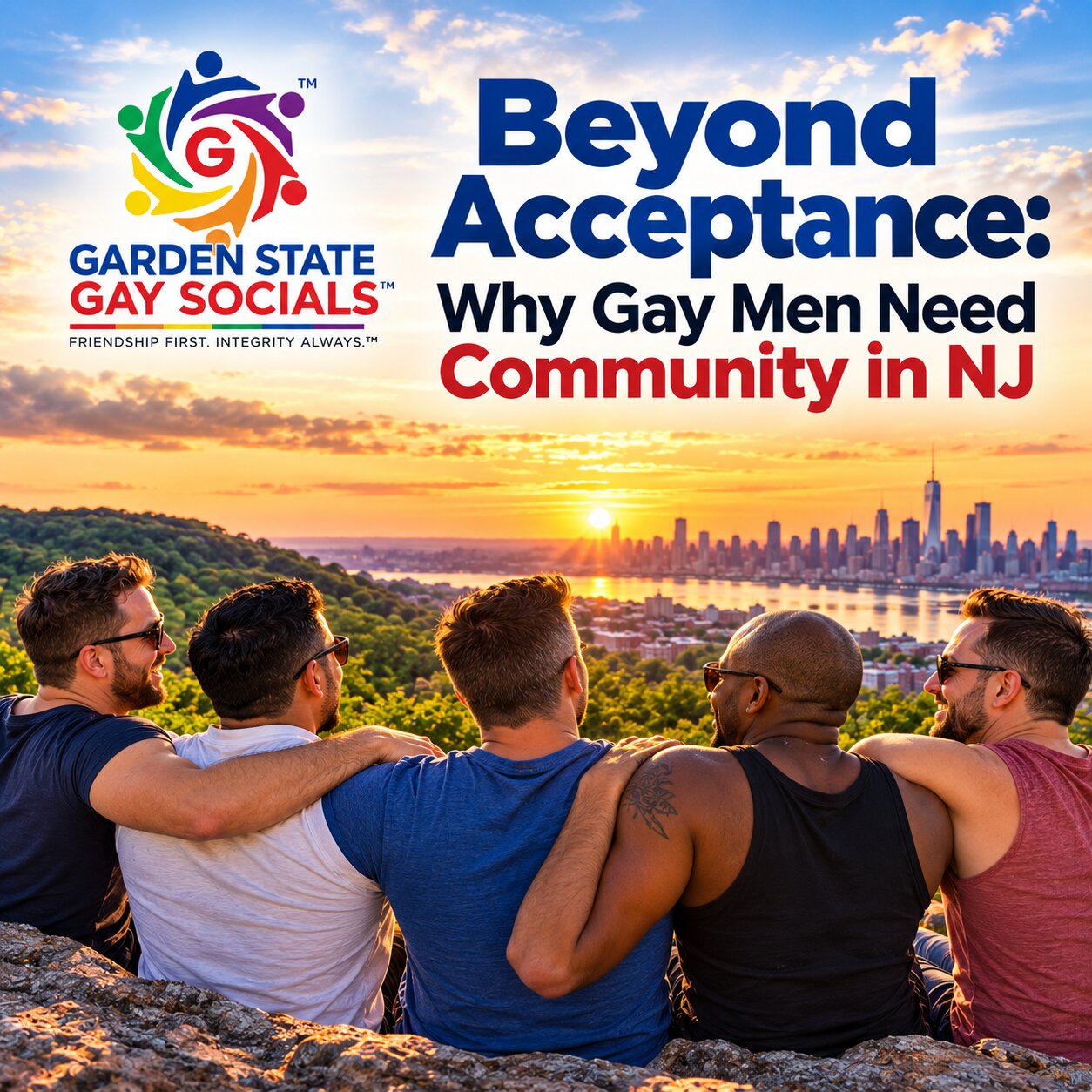
Beyond Acceptance: Why Gay Men Need Community in NJ
An exploration of belonging, shared values, and the importance of building meaningful social connections among gay men throughout New Jersey.
Acceptance Opens Doors. Community Creates Belonging.
Acceptance is essential to a society where people can live authentically, pursue their interests, and participate without fear of unfair exclusion. For gay men, greater LGBTQ+ visibility and opportunities for inclusion represent important developments. Yet acceptance, however meaningful, is not necessarily the same as belonging.
A person can live in an accepting neighborhood, work alongside supportive colleagues, and maintain positive family relationships while still feeling that something is missing from his social life. He may have acquaintances, professional contacts, and online connections without having a dependable circle of friends with whom he regularly shares meaningful experiences.
This distinction raises an important question: What does it truly mean to belong to a community?
Belonging is more than being welcomed into a particular environment. It involves opportunities to participate, develop trust, establish relationships, and feel recognized as an individual.
For gay men throughout New Jersey, community can provide an important setting for those experiences. It can introduce people to shared interests, encourage cross-generational interaction, and create opportunities for friendships that develop naturally over time.
At Garden State Gay Socials™, we believe the quality of social experiences matters just as much as their availability.
Our philosophy reflects that commitment:
Friendship First. Integrity Always. ™
We recognize that meaningful community cannot be created simply by scheduling events or bringing people into the same room. It develops when individuals have opportunities to interact respectfully, discover common interests, and participate in experiences that enrich their lives.
Understanding the difference between acceptance and belonging is an important starting point.
- Understanding the Difference Between Acceptance and Belonging
Acceptance and belonging are related concepts, but they address different dimensions of the human experience.
Acceptance concerns how individuals are treated. It includes recognition, fairness, and the ability to participate without discrimination.
Belonging concerns how individuals experience their relationships and environments. It involves familiarity, trust, mutual respect, and a sense that participation matters to them personally.
A man may be accepted by everyone around him yet still have limited opportunities to develop friendships with other gay men.
Another may participate in large LGBTQ+ celebrations while wishing for smaller, more personal gatherings.
Neither situation diminishes the importance of acceptance. Instead, both illustrate why inclusion must extend beyond public recognition.
A welcoming environment provides access. A meaningful community creates opportunities for ongoing interaction.
These opportunities matter because relationships develop through experience, not declarations alone.
People gradually learn about one another through conversations, shared activities, common interests, and consistent behavior.
Over time, those interactions may create familiarity and trust.
Not every introduction becomes a friendship, and no organization can guarantee a particular personal outcome. Nevertheless, thoughtfully organized social experiences can create the conditions for meaningful relationships to develop.
For men interested in exploring these opportunities, our guide to building genuine friendships through gay social events in New Jersey examines how participation can contribute to lasting social connections.
The broader principle is straightforward: acceptance matters, but building meaningful relationships deserves its own attention.
- Why Gay Men's Community Remains Important
New Jersey offers a diverse range of social, cultural, recreational, and professional opportunities.
Residents can explore restaurants, museums, parks, entertainment destinations, community organizations, and regional attractions. The state's proximity to New York City and Philadelphia also provides access to substantial metropolitan resources.
However, access to activities does not automatically translate into meaningful social participation.
Many adults experience changes in their social lives as their circumstances evolve.
Professional responsibilities may become more demanding. Friends may relocate. Family commitments can influence available time. Personal interests may change, and relationships that once developed through school or work may become less frequent.
These experiences are not unique to gay men, but gay men may have additional reasons for seeking social opportunities with others who share aspects of their identity.
Some appreciate environments where they can discuss everyday experiences without needing to explain their identity.
Others want friendships that are not organized around dating or romantic expectations.
Still others enjoy spending time with gay men who share an interest in recreation, culture, food, travel, or local activities.
There is no universal motivation.
A community should recognize that gay men have different personalities, backgrounds, relationship statuses, and social preferences.
A friendship-focused organization does not prescribe how individuals should live. It provides opportunities for those who value its approach.
GSGS contributes to this landscape by offering organized social activities for gay men in New Jersey that emphasize shared experiences and respectful participation.
- The Difference Between Social Contact and Genuine Connection
Technology has dramatically expanded the ways people communicate.
Social media, messaging platforms, online communities, and professional networks let people stay in touch with others across significant distances.
These tools can be valuable. They help individuals discover organizations, maintain friendships, share information, and coordinate activities.
Yet frequent communication does not always produce deeper relationships.
A person may interact with dozens of individuals online while rarely having opportunities for extended in-person conversation.
He may recognize many names and faces without feeling particularly close to anyone.
Similarly, attending a crowded gathering does not guarantee meaningful interaction.
Connection involves more than proximity.
It often requires attention, mutual interest, consistency, and a willingness to get to know another person.
Shared experiences can support that process.
During a meal, participants may discover similar interests or experiences.
At a recreational activity, they may interact naturally as they participate.
During a cultural outing, conversations may develop around the destination or exhibition.
These interactions can provide starting points for relationships without requiring participants to manufacture conversation.
Our article on how shared activities build gay friendships explores this relationship between participation and connection in greater detail.
The important distinction is that meaningful social interaction requires more than simply increasing the number of people someone encounters.
Community is strengthened by the quality of interactions, not merely their frequency.
- Why Local Community Matters in North Jersey
For North Jersey residents, proximity to major metropolitan areas creates considerable opportunity. Nevertheless, local and regional social experiences remain important.
Not everyone wants to travel into Manhattan or Philadelphia for every social outing.
Transportation, parking, travel time, costs, and scheduling all influence whether an activity is practical.
Someone living in Bergen County may prefer an occasional restaurant gathering or recreational activity closer to home.
A Morris County resident may appreciate opportunities to explore nearby cultural destinations or outdoor attractions.
Men living in Passaic, Essex, Sussex, Somerset, and surrounding counties may similarly value regional experiences that fit their interests and schedules.
Local activities can make social participation more convenient while introducing people to places they might otherwise overlook.
They also let people explore the communities around them.
A person may discover a restaurant he has never visited, a recreational activity he has not tried, or a cultural destination he did not know existed.
These experiences can be enjoyable even without developing friendships.
For readers exploring local opportunities, our article on where gay men meet in Bergen, Morris, and Passaic counties provides additional regional context.
Local community does not replace larger LGBTQ+ institutions or urban social opportunities.
It complements them by expanding individuals' choices.
A strong community landscape should offer different kinds of experiences for people with different preferences.
- Friendship as a Purpose, Not an Afterthought
Social gatherings can serve many purposes.
Some focus on entertainment. Others emphasize professional networking, dating, education, advocacy, or cultural celebration.
Each may provide meaningful value.
However, organizations that prioritize friendship offer a distinctive experience.
They create opportunities for people to participate without making romantic interest, professional advancement, or social status the central expectation.
This distinction matters because individuals approach social situations with different goals.
A gay man may want to enjoy dinner with other men without feeling that he must pursue a romantic connection.
Another may want to try bowling, painting, hiking, or a cultural outing because the activity itself appeals to him.
Someone else may appreciate a welcoming environment where he can gradually get to know other participants.
At GSGS, friendship is not treated as an incidental possibility.
It is central to our organizational philosophy.
That does not mean every participant must develop a friendship or that every interaction will result in an ongoing relationship.
Friendships remain personal relationships based on mutual choice.
Our responsibility is to provide opportunities for participation and interaction in an environment that reflects our values.
This approach is consistent with the principles discussed in our article on friendship-first gay communities in New Jersey.
The essential idea is that people should be able to enjoy social experiences without pressure to pursue relationships they do not want.
- Creating Community Across Generations
One strength of a diverse adult community is the opportunity for people from different generations to interact.
Gay men do not share a single life story.
Their experiences may be shaped by age, upbringing, education, profession, family relationships, cultural background, and personal circumstances.
A younger adult may be establishing his career and exploring new interests.
Someone in midlife may be balancing professional responsibilities and personal commitments.
An older adult may be navigating retirement, relocation, or a changing social routine.
These examples are not fixed categories. People of any age may share similar interests or face comparable circumstances.
Intergenerational participation can create opportunities for unexpected friendships.
Two men separated by decades in age may discover a shared appreciation for music, travel, art, technology, or local history.
They may have different perspectives on certain subjects while still enjoying one another's company.
Such relationships are most constructive when participants approach each other as individuals.
Younger people should not be stereotyped as inexperienced.
Older people should not be treated as disconnected from contemporary interests.
Respectful interaction lets people find common ground without assuming age determines compatibility.
A community committed to genuine belonging should recognize the value of these differences.
The objective is not to erase generational distinctions but to make room for relationships that extend beyond them.
- Belonging Without Conforming to Stereotypes
No single lifestyle defines the experience of being a gay man.
Some enjoy nightlife, festivals, and large public gatherings.
Others prefer quieter restaurants, outdoor recreation, cultural attractions, or small-group activities.
Some are naturally outgoing, while others prefer time to become comfortable in unfamiliar environments.
Some are single, partnered, or married. Others may have different personal circumstances.
These differences should not determine whether someone is treated with respect.
A welcoming community does not require participants to adopt a particular personality, appearance, or set of interests.
It recognizes that individuality makes social interaction worthwhile.
Belonging should not depend on popularity, income, professional status, or conformity to a stereotype.
Instead, participation should be grounded in shared expectations about conduct.
At Garden State Gay Socials™, our Code of Conduct establishes standards for respectful participation.
Those standards help communicate that community involves both individual freedom and responsibility toward others.
A person should be able to enjoy an activity without feeling pressured to perform a particular version of gay identity.
Likewise, he should recognize that other participants may have different interests, boundaries, and communication preferences.
Authentic belonging requires room for individuality.
- The Role of Small-Group Experiences
Large events can provide energy, visibility, and entertainment.
Pride celebrations, festivals, concerts, and public gatherings offer opportunities that many people value.
Smaller social experiences offer a different environment.
They may help participants get to know one another more easily, talk without competing with large crowds, and focus on a shared activity.
A small group enjoying dinner may have opportunities for extended discussion.
During a game night, participants can interact through the activity itself.
A guided creative workshop can provide structure while allowing conversation to develop naturally.
A recreational outing may create opportunities to interact during breaks or between activities.
These environments can be particularly appealing to individuals who prefer a more personal atmosphere.
However, smaller attendance does not automatically produce better relationships.
Organization, communication, participant conduct, and the activity's suitability all shape the experience.
The goal should be to create a comfortable, enjoyable environment rather than assume a particular group size guarantees success.
Our discussion of why some gay men prefer smaller social gatherings examines this preference in greater detail.
At GSGS, smaller social experiences are an important part of our approach because they can support personal interaction.
The activity provides the setting.
Participants determine how their relationships develop.
- Community Culture Begins With Shared Values
An organization may attract participants through an appealing event calendar, but its culture is shaped by more than the activities it offers.
Culture develops through communication, expectations, and behavior.
Do participants treat one another respectfully?
Are personal boundaries recognized?
Is event information communicated clearly?
Are concerns handled appropriately?
Do organizers and participants demonstrate consideration for venues and other guests?
These questions are important because trust depends on conduct.
A welcoming atmosphere cannot be created through promotional language alone.
It must be reflected in the experience.
At Garden State Gay Socials™, Friendship First. Integrity Always.™ communicates the principles we seek to uphold.
Friendship First emphasizes authentic social interaction rather than competition, status, or romantic expectations.
Integrity Always emphasizes honesty, accountability, courtesy, and respectful behavior.
These principles apply to both organizers and participants.
An organization must communicate accurately and set appropriate expectations.
Participants must conduct themselves respectfully and respect others' boundaries.
A constructive community requires contributions from both.
- Trust, Transparency, and Responsible Participation
Trust is especially important when someone considers attending an event for the first time.
He may not know the organizer or other participants.
He may be unfamiliar with the venue or the activity.
He may have questions about registration, costs, expectations, or event procedures.
Providing clear information can help him make an informed decision.
An organization should communicate what an event involves, what participants should expect, and what conditions apply.
Transparency also includes making relevant policies accessible.
Garden State Gay Socials™ provides information about membership benefits and participation options, allowing visitors to review the available choices.
Participants can also consult the organization's refund policy before registering for applicable activities.
These resources contribute to a more informed experience.
Trust continues to develop after registration.
Participants notice whether an event matches its description and whether interactions reflect the organization's stated values.
They also observe how concerns are addressed and whether expectations are applied fairly.
Over time, responsible conduct can help strengthen confidence.
Integrity is not simply a value an organization announces. It is a standard demonstrated through its actions.
- Why Familiarity Matters in Developing Friendships
Meaningful relationships often develop gradually.
A first encounter may involve a simple introduction.
A second meeting may create an opportunity to continue a previous conversation.
Later interactions may reveal additional common interests or compatible personalities.
This progression isn't guaranteed, and it doesn't happen at the same pace for everyone.
Some individuals establish rapport quickly.
Others prefer to get to know people over time.
Repeated opportunities for interaction can support both approaches.
An organization offering varied activities may give participants opportunities to recognize one another in different settings.
Someone attending a restaurant gathering may later encounter a familiar participant during a recreational outing.
Someone who enjoys a cultural activity may discover another shared interest at a later event.
These experiences can help move relationships beyond initial introductions.
Our article on why familiar faces make social events better explores the value of recognition and recurring interaction.
The important point is that community provides opportunities for relationships to develop without requiring immediate intimacy.
A pleasant conversation can be valuable even when it stays pleasant.
Friendship should develop through mutual interest rather than expectation.
- The Importance of Being Recognized as an Individual
Belonging is sometimes expressed through ordinary moments.
Someone remembers your name.
A participant recalls an interest you mentioned previously.
A familiar face greets you when you arrive.
Another person asks about an activity you enjoyed.
These interactions may appear small, but they can communicate attention and recognition.
They suggest someone has noticed you as an individual, not just another attendee.
Recognition does not require elaborate gestures.
It may involve listening carefully, remembering a conversation, or making room for someone to participate.
A community can encourage this culture through ordinary courtesy.
Returning participants may welcome newcomers.
People can include others in conversations without putting them on the spot.
Organizers can communicate respectfully and recognize that participants have different comfort levels.
Not everyone enjoys the same degree of attention.
Some appreciate enthusiastic introductions. Others prefer quieter interaction.
Respecting these differences helps create an inclusive social environment.
A sense of belonging develops when individuals can participate authentically, not when they are pressured to behave the same way.
- Supporting Social Opportunities During Life Transitions
Life changes can influence the availability and character of friendships.
Relocation may separate someone from familiar social circles.
A career change may alter his schedule.
Retirement may create additional leisure time while reducing everyday workplace interaction.
Changes in personal relationships may also lead someone to reconsider how he spends his free time.
These circumstances are common across adulthood, although individuals experience them differently.
For gay men navigating transitions, organized social experiences can offer opportunities to explore new interests and meet people.
Someone who has recently moved to New Jersey may appreciate activities that introduce him to local destinations.
An established resident may want to expand his social circle after years of following familiar routines.
A person whose interests have changed may enjoy trying an activity he has never considered.
These motivations are all legitimate.
Participation does not require a dramatic life event or a particular explanation.
People can become involved simply because an experience interests them.
Our guide to building a social life as a gay man in New Jersey offers additional perspective on exploring opportunities and developing social routines.
Community should provide choices rather than prescribe personal outcomes.
- Participation Should Be Welcoming, Not Obligatory
A healthy community recognizes that individuals have responsibilities and interests beyond any single organization.
People balance employment, family commitments, finances, personal relationships, and other activities.
Some may participate frequently.
Others may attend occasionally when an event fits their schedules.
Someone may follow an organization's announcements for an extended period before deciding to register.
These differences should not be treated as measures of personal worth or loyalty.
A welcoming organization should make participation understandable without suggesting that people must attend every gathering to belong.
Social experiences should enrich people's lives rather than become another source of pressure.
This matters especially for adults whose time may be limited.
Someone who attends only a few events each year can still have a worthwhile experience.
Someone who participates regularly may appreciate getting to know other attendees.
Neither approach is inherently superior.
Garden State Gay Socials™ provides membership information so individuals can review their options and determine what suits them.
The purpose is to encourage informed, voluntary participation.
A meaningful community respects individual choice.
- The Relationship Between Community and Emotional Well-Being
Social relationships can contribute to a fulfilling life, but community involvement is not a universal solution to loneliness or emotional difficulties.
People experience loneliness for many reasons.
Some may want more frequent social interaction.
Others may have numerous acquaintances but desire deeper relationships.
Some may be navigating personal circumstances that require support beyond recreational activities.
An organized social group cannot guarantee emotional well-being or resolve every challenge.
It can provide an opportunity to participate.
A person may enjoy a shared experience, discover a new interest, or meet someone they would not otherwise have met.
These outcomes can be meaningful without being presented as therapeutic results.
Responsible community organizations should communicate their purpose accurately.
They should not imply that attendance guarantees happiness, confidence, or lasting friendships.
At GSGS, we focus on enjoyable social experiences and opportunities for authentic interaction.
Participants determine what those experiences mean to them.
Community can be one valuable part of a person's broader social life while complementing family relationships, existing friendships, personal interests, and other sources of support.
- Why Community Is More Than an Event Calendar
An event calendar is an important organizational resource.
It communicates upcoming opportunities and helps participants plan.
However, a calendar alone does not establish a meaningful community.
Community develops through the experience surrounding those events.
It involves expectations, values, communication, participation, and the relationships that may continue afterward.
An organization can schedule many activities without necessarily creating a strong sense of connection.
Conversely, a modest gathering can provide considerable value when it is well organized and aligned with participants' interests.
Attendance numbers measure activity, but they do not fully capture the quality of an experience.
A more complete evaluation considers whether participants were treated respectfully, whether the event delivered what was communicated, and whether the activity was enjoyable.
These considerations help distinguish event production from community development.
For GSGS, the upcoming events calendar provides a practical way to discover activities.
Our organizational philosophy provides the broader context.
We believe activities should create opportunities for friendship and meaningful shared experiences.
The calendar tells people what is happening.
The values explain why the organization exists.
- Building Relationships Beyond a Single Gathering
A community becomes more meaningful when people have opportunities to keep relationships going beyond one event.
This does not mean every participant should exchange contact information or arrange future activities.
Personal relationships remain voluntary.
However, recurring social opportunities can create circumstances in which people naturally become more familiar with one another.
Two participants may discover that they enjoy similar activities.
They may recognize one another at future gatherings.
Eventually, they may decide to communicate or make plans on their own.
Other participants may prefer to keep their social interaction within organized events.
Both approaches are valid.
Community should respect different preferences regarding personal contact.
A healthy environment doesn't pressure individuals to share private information or pursue relationships they don't want.
Instead, it lets connections develop at a pace that feels right for the people involved.
Our article about how acquaintances become friends among gay men in New Jersey explores this gradual progression.
The larger lesson is that meaningful relationships develop through mutual choice, not organizational promises.
- The Broader LGBTQ+ Community Has Many Important Roles
LGBTQ+ community life includes organizations serving a wide range of purposes.
Some emphasize advocacy and public policy.
Others focus on education, cultural programming, health resources, professional development, or community celebrations.
Recreational and friendship-oriented organizations contribute another dimension.
These different missions can complement one another.
An individual may participate in advocacy through one organization, attend educational programs through another, and enjoy recreational activities through a social group.
No single organization needs to provide every type of community service.
A strong community landscape benefits when different organizations contribute their strengths.
Cooperation can also create opportunities for greater awareness and participation.
However, organizations should approach collaboration responsibly.
Formal partnerships should be described accurately, and expectations should be clear to both parties.
At Garden State Gay Socials™, we recognize the importance of the broader LGBTQ+ community while maintaining our specific focus on friendship-oriented social experiences.
We create opportunities for gay men to enjoy activities and meet others in a respectful environment.
That mission can coexist with organizations pursuing different objectives.
- Every Participant Contributes to Community Culture
Community culture is shaped by the conduct of everyone involved.
Organizers set expectations and coordinate activities, but participants shape how welcoming the experience feels.
A friendly greeting may help someone become comfortable.
Thoughtful listening can make a conversation more meaningful.
Respecting boundaries can prevent unnecessary discomfort.
Making room for another participant in a discussion can help create a more inclusive atmosphere.
These actions do not require formal leadership positions.
They reflect ordinary consideration.
A returning participant may recognize someone attending for the first time and offer a welcoming introduction.
Another may notice that someone hasn't had a chance to contribute to a conversation.
Someone else may thank an organizer or offer constructive feedback after an activity.
Community also requires accountability.
Respectful participation does not mean ignoring inappropriate conduct or expecting individuals to tolerate behavior that violates their boundaries.
Clear standards are essential.
Our community Code of Conduct helps establish those expectations.
When organizers and participants recognize their responsibilities, they help create an environment where people can participate with greater confidence.
- The Future of Gay Men's Community in New Jersey
The ways people discover social opportunities will continue to evolve.
Technology will influence event promotion, communication, and registration.
Different generations will bring different interests and expectations.
New venues, destinations, and activities will create additional possibilities.
Yet the underlying value of meaningful human interaction remains relevant.
People will continue to appreciate opportunities to share experiences, explore interests, and develop relationships.
For gay men in New Jersey, a strong community landscape should offer a variety of choices.
Large public celebrations can increase visibility and create shared experiences.
Cultural organizations can create opportunities for education and expression.
Advocacy groups can pursue important institutional and social objectives.
Smaller friendship-focused organizations can provide opportunities for personal interaction and recreation.
These roles are complementary.
The future of community should not depend on everyone choosing the same kind of social experience.
It should offer different opportunities and let individuals choose what suits their lives.
Garden State Gay Socials™ contributes by offering experiences grounded in friendship, integrity, and shared interests.
We recognize that successful community development requires consistency, thoughtful organization, and a willingness to listen to participants.
Our commitment is to those principles rather than to any single activity or trend.
- What Garden State Gay Socials™ Stands For
Garden State Gay Socials™ is founded on the belief that adult gay men deserve opportunities to enjoy shared experiences and develop genuine social connections in respectful environments.
Our approach emphasizes friendship rather than dating or hookup expectations.
We value small-group experiences that encourage natural interaction.
We recognize that participants have different interests, backgrounds, personalities, and schedules.
We believe clear communication and responsible organization are essential.
And we recognize that relationships cannot be manufactured or guaranteed.
We can provide opportunities for people to meet, participate, and discover whether meaningful connections develop.
Our activities may include recreational experiences, meals, creative workshops, cultural destinations, seasonal outings, and other shared interests.
Each offers a different way to participate.
Some men may attend independently.
Others may participate with existing friends.
Some may return frequently, while others may attend occasionally.
These differences support a healthy, voluntary community.
Visitors who would like to understand our organization can explore the Garden State Gay Socials About Us page and review our membership benefits.
Our objective is not to tell people what their social lives should look like.
It is to create worthwhile opportunities for those who appreciate our friendship-first philosophy.
- Beyond Acceptance: Creating Opportunities to Belong
Acceptance remains essential.
Everyone deserves dignity, respect, and the chance to participate without unfair exclusion.
But genuine belonging involves something more personal.
It develops when people can get to know one another, share experiences, and build relationships based on mutual interest.
For gay men in New Jersey, those experiences can take many forms.
Belonging may begin with a conversation at a restaurant.
It may develop through a recreational activity or cultural outing.
It may involve recognizing familiar faces at a future gathering.
Or it may simply mean finding an environment where someone feels comfortable being himself.
Not every activity will appeal to everyone.
Not every introduction will lead to friendship.
And no organization can promise that every participant will experience the same outcome.
Nevertheless, meaningful community begins by creating opportunities.
It requires respect for individuality, clear expectations, and consistent conduct.
It benefits from participants who recognize the importance of courtesy, personal boundaries, and shared responsibility.
Most importantly, it recognizes that friendship deserves to be valued for its own sake.
At Garden State Gay Socials™, these principles shape our purpose.
We believe social experiences should offer more than a calendar appointment.
They should provide opportunities to enjoy life, discover interests, and connect with others in a welcoming environment.
Acceptance opens the door. Meaningful community creates the opportunity to belong.
Discover Your Next GSGS Experience
Whether you are new to North Jersey, returning to social activities after time away, or simply interested in meeting other gay men through shared experiences, Garden State Gay Socials™ welcomes you to explore what our organization offers.
Start by browsing our upcoming events and activities, review scheduled experiences, and choose those that appeal to you.
You can also learn more about membership options and benefits and explore the values behind our friendship-first community.
Your next meaningful social experience may begin with an activity you already enjoy or a destination you have never visited.
The important thing is having the opportunity to participate.
Garden State Gay Socials™
Friendship First. Integrity Always. ™
Leave A Comment
Please login to add a comment!
Comments (0)