How Shared Activities Build Gay Friendships
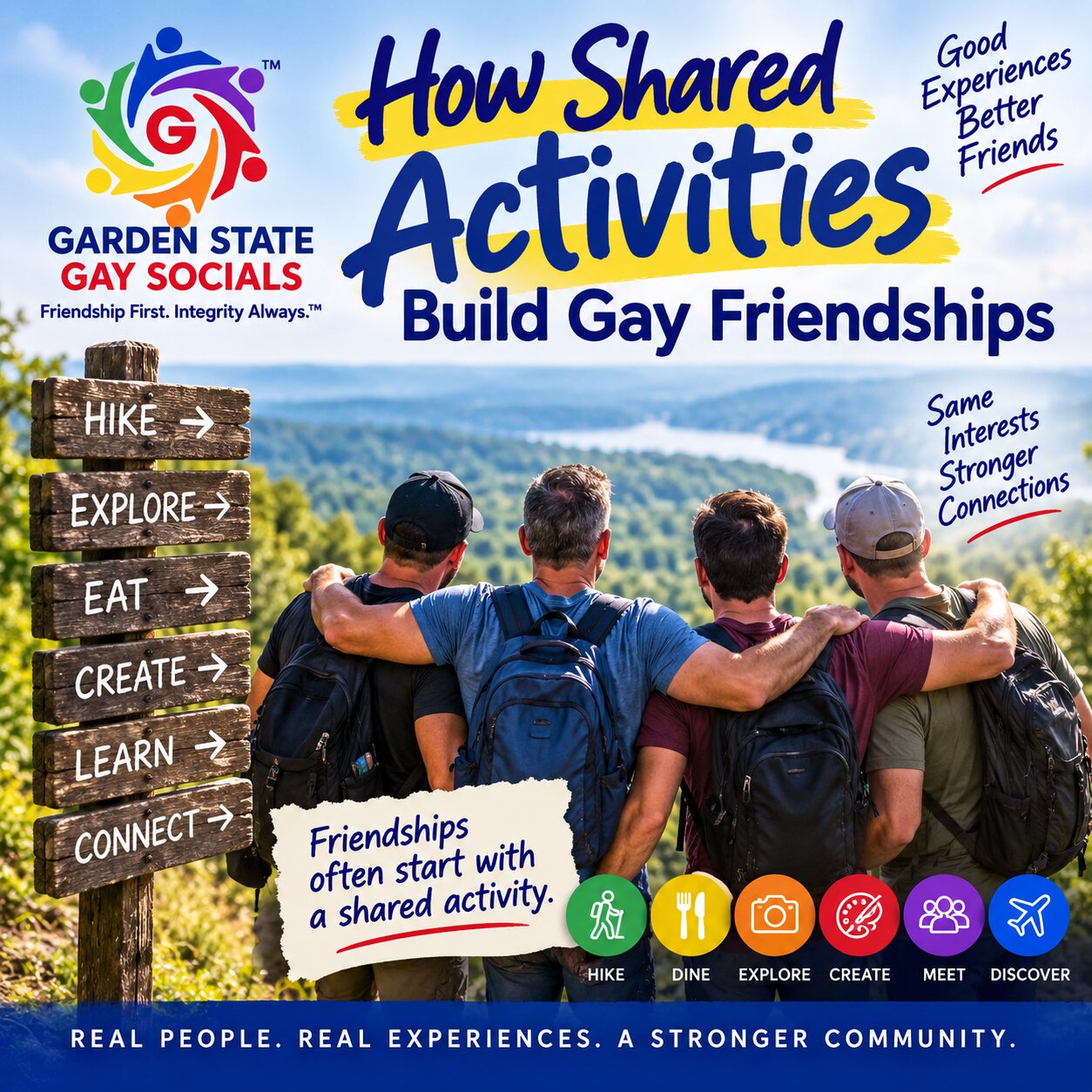
How Shared Activities Build Gay Friendships
Making new friends as an adult can feel surprisingly complicated. Most people understand the value of friendship and recognize the importance of having people they can share their lives with, yet knowing that friendship matters doesn't necessarily make forming new relationships easier.
For gay men, the challenge can be particularly noticeable. Someone may want a broader circle of friends, more people to enjoy weekends with, or simply more opportunities for genuine conversation, but the traditional instruction to “go out and meet people” offers little practical guidance. Walking into a room full of strangers and trying to build friendship through conversation alone can feel unnatural, especially when everyone knows they are there to meet new people.
Shared activities change that dynamic.
When people have something to do together, the activity provides an immediate point of connection. Instead of making friendship the assignment, people can concentrate on the experience in front of them. They can hike a trail, paint a canvas, explore a town, enjoy a meal, visit a cultural attraction, learn something new, or join an activity that gives everyone a reason to be there beyond simply introducing themselves.
That difference may appear subtle, but it can fundamentally change how people interact. Friendship does not have to begin with an important conversation. Sometimes it begins because two people happen to be doing the same thing at the same time and discover that they enjoy each other’s company.
Friendship Is Easier When It Is Not the Assignment
There is an inherent pressure in entering a social environment with the expectation that you are supposed to make friends. Who should you approach? What should you say? How long should you talk? Is the other person interested in continuing the conversation? Should you exchange contact information? What happens if the conversation becomes quiet?
The more we think about these questions, the less natural the interaction can become.
An activity provides another focus. Two people walking along a trail do not need to maintain uninterrupted conversation because the hike itself is part of the experience. People participating in a creative activity can discuss what they are making. A day trip provides places to explore and things to notice. A meal creates natural pauses and opportunities for conversation without requiring anyone to carry the interaction continuously.
The purpose of the gathering is no longer to talk to strangers. Everyone is there to experience something, which gives friendship room to develop without demanding it.
For naturally outgoing people, this may make an enjoyable experience even better. For people who are quieter, reserved, or uncomfortable in unfamiliar social settings, having something to do can significantly reduce the pressure of meeting new people.
Activities Give People Something Immediate to Talk About
One of the simplest advantages of a shared activity is also one of the most important: it provides conversation material.
Meeting someone without any context can make the first few minutes feel like an interview. Where do you live? What do you do? How did you hear about this? Have you been here before?
Those questions aren't inherently wrong, but when every introduction follows the same pattern, conversations can stay on the surface.
An activity creates context immediately. During a hike, people might talk about other trails they have explored. At a restaurant, conversation may begin with food and lead to favorite places, travel experiences, cooking, or family traditions. A historical destination can lead to conversations about places someone has visited. A creative experience can reveal a sense of humor, patience, curiosity, or willingness to try something unfamiliar.
The conversation has somewhere to begin. From there, it can go almost anywhere.
This is one reason activity-based interaction can feel more natural than simply placing people in a room and expecting them to discover common ground. The shared experience automatically provides the first piece of common ground.
We Learn About People Differently When We Do Things Together
Conversation tells us a great deal about another person, but activities reveal things conversation alone may not.
We see how someone reacts when plans change. We notice whether he is curious about something unfamiliar. We discover his sense of humor when something unexpected happens. We see whether he encourages others, listens, participates, takes himself seriously, or is comfortable laughing at his own mistakes.
These small observations help us understand personality.
A person can tell us that he enjoys adventure, but spending a day exploring somewhere new shows us what adventure means to him. Someone can describe himself as easygoing, but sharing an experience gives us a chance to see that quality in action.
This does not mean we should evaluate every person we meet or treat a social activity as an audition for friendship—quite the opposite. Activities can make interaction feel less evaluative because people are not required to explain who they are. Their personalities emerge gradually through participation, conversation, humor, choices, and reactions.
We begin to know someone through experience rather than biography alone.
Common Interests Can Create an Easy Starting Point
Shared interests have always been one of the most natural foundations for friendship.
People join sports teams, volunteer organizations, clubs, professional associations, classes, religious communities, recreational groups, and countless other organizations partly because a common interest brings them into contact.
The same principle applies when gay men participate in shared activities.
Someone who enjoys hiking already has something in common with another person who willingly spends a Saturday morning on a trail. Two people attending a culinary experience may discover a mutual enthusiasm for restaurants or cooking. Men who choose a museum, historical destination, live performance, or creative activity start with at least one point of shared curiosity.
That commonality does not guarantee friendship, nor should it. What it does provide is an opening.
From there, people may discover other interests in common. They may realize they live near one another, work in related fields, enjoy similar travel destinations, share a particular sense of humor, or have remarkably different backgrounds that make conversation even more interesting.
Friendship frequently begins with one small point of connection and expands from there.
Different Activities Attract Different Personalities
There is no single activity that appeals to every gay man. That is an advantage, not a problem.
A person who loves hiking may have little interest in painting. Someone fascinated by food and culinary experiences may not want to spend several hours on a trail. Another person may be enthusiastic about history, travel, seasonal activities, live entertainment, or exploring unfamiliar places.
Different experiences create different environments, and those environments can attract different personalities. They can also reveal different sides of the same person.
Someone who is relatively quiet during breakfast may become animated during a museum visit because the subject genuinely interests him. A person who seems reserved at dinner may be considerably more relaxed outdoors. Someone who says very little during an initial introduction may become highly engaging once the conversation turns toward an interest he cares about.
This is why variety matters when building a social life. If every social opportunity follows the same format, people have fewer chances to discover where they feel most comfortable and who they naturally connect with.
Different settings create different possibilities.
Activities Can Reduce the Pressure of Walking Into a Room Alone
Attending something alone is one of the biggest barriers many adults face when considering a new social experience.
Walking into an unfamiliar room where everyone appears to know someone else can be intimidating, even for people who are generally confident. There can be an immediate feeling that everyone else has already found his place and that you are somehow arriving late to a social circle that was established before you entered.
An activity can soften that experience because it gives you a clear reason to be there. You are not simply standing in a room waiting for someone to approach you. There is somewhere to go, something to see, something to make, something to eat, or something to participate in.
The activity provides structure.
That structure can be especially valuable during the first few minutes of an unfamiliar gathering, when uncertainty is usually at its highest. Once people begin participating, introductions and conversations often become easier because attention shifts away from the discomfort of arriving alone.
The experience becomes the common denominator. Everyone came for the same reason, even if they arrived from different places.
Conversation Does Not Have to Carry the Entire Experience
Good conversation is an important part of friendship, but requiring conversation to carry an entire social interaction can create unnecessary pressure.
Shared activities naturally create pauses. During a hike, people may walk quietly for several minutes. At a performance, attention turns toward what is happening in front of the group. During a creative activity, everyone may concentrate temporarily on what he is doing. During a meal, conversation moves among different people and subjects.
Silence does not automatically signal that an interaction has failed.
This matters because genuine friendship rarely consists of nonstop conversation. Comfortable relationships have rhythm. People talk, observe, laugh, participate, listen, and occasionally say nothing.
Activities let that rhythm show up even during early interactions. For someone who dislikes traditional networking environments or the feeling that he must constantly produce conversation, this can make meeting people substantially more comfortable.
Doing Something Together Creates a Different Kind of Memory
Consider how many introductions we experience and quickly forget.
Someone tells us his name, where he lives, and perhaps what he does professionally. We have a pleasant conversation, leave, and several weeks later remember very little about the encounter.
Activities provide context that can make people more memorable.
Instead of remembering only that you met someone named David, you may remember David as the guy who made everyone laugh during the painting activity. You may remember the person you spoke with during a particular section of a hike, the person sitting across from you during lunch, or the guy who recommended another place everyone should visit.
The person becomes associated with a moment, and that gives future conversations somewhere to restart.
The next time two people see one another, they don't necessarily have to start from zero. They already share a reference point. “Did you ever try that restaurant you mentioned?” “Have you been hiking since we last talked?” “I still can’t believe how that painting turned out.”
Those small callbacks create continuity, and continuity is often where acquaintanceship begins moving toward friendship.
Shared Activities Make Follow-Up More Natural
One of the hardest transitions in adult friendship happens after two people meet.
The initial interaction may have gone well, but what happens next?
A purely conversational encounter can leave people uncertain about how to continue the relationship. Reaching out without a reason may feel awkward, particularly when two people barely know one another.
A shared interest can provide that reason.
If two people discover they both enjoy hiking, one can suggest another trail. If they talk about restaurants, one can recommend trying a place they discussed. If they share an interest in history, theater, travel, art, or another activity, they already have a natural subject for a future invitation.
The invitation does not need to carry the emotional weight of “Would you like to become friends?” It can simply be, “Would you like to do this?”
That is a much easier question.
Friendship can then develop through the experience rather than through a formal decision to become friends.
Not Every Activity Needs to Produce a Friendship
It is equally important to remove another expectation: participating in an activity does not mean everyone should leave with new close friends.
Sometimes you have an enjoyable afternoon. Sometimes you meet several interesting people. Sometimes you have one particularly good conversation. Sometimes you discover that you enjoy an activity more than you expected. And sometimes you meet someone you genuinely want to know better.
All of those outcomes can make an experience worthwhile.
When we evaluate every social opportunity by whether it immediately produces friendship, we set a standard that human relationships were never designed to meet.
Friendship develops through compatibility, timing, repeated interaction, trust, and mutual interest. You can't manufacture those elements simply because two people attend the same activity.
An activity can provide opportunity. It creates a setting in which people can interact naturally enough to discover whether there is a reason to continue.
Repetition Changes the Nature of the Experience
The first time someone attends an unfamiliar activity, much of his attention may be devoted simply to understanding the environment. Where should I go? Who is here? What happens next? Who should I talk to?
The second experience can feel different because some of those questions have already been answered.
A face may look familiar. Someone remembers your name. A conversation from the previous experience continues. You recognize the organizer. You understand the general atmosphere.
By the third or fourth interaction, something else may begin to happen: familiarity.
Familiarity is not the same as friendship, but it creates conditions in which friendship can develop more comfortably.
This is why a varied social calendar can be more valuable than a collection of unrelated one-time encounters. People can see one another in different environments, discover additional common interests, and gradually move beyond introductory conversation.
The relationship has room to develop naturally.
The Activity Matters, but the People Matter More
A good activity gives people a reason to participate, but the lasting value of a social experience often has less to do with the activity than we initially expect.
Someone may register because he wants to hike, paint, explore, eat, travel, or experience something new. He may return because of the people.
This is an important distinction.
Activities can open the door, but relationships are what can transform isolated experiences into a meaningful social life. The best environments recognize both sides of that equation. The experience should be worthwhile in its own right, while also creating enough space for people to talk, interact, and become comfortable with one another.
If an activity is so structured that nobody has an opportunity to communicate, it may be entertaining without being particularly social. If there is no activity or shared focus at all, some people may feel as though the entire responsibility for creating a successful experience rests on their ability to make conversation.
A thoughtful balance gives people something worth doing and enough room to discover whom they enjoy doing it with.
Why This Matters for Gay Men in New Jersey
New Jersey offers an unusually broad range of possibilities for shared experiences. New Jersey offers hiking trails, restaurants, cultural attractions, historic destinations, seasonal festivals, creative activities, entertainment, shore communities, scenic areas, and countless opportunities for day trips throughout New Jersey and the surrounding Tri-State region.
For gay men looking to expand their friendships, this variety creates an important opportunity.
Meeting people does not have to mean repeatedly entering the same type of social environment. Someone who does not enjoy one format may feel completely comfortable in another. A man who has little interest in nightlife may discover that he enjoys meeting people while hiking or exploring a new destination. Someone who dislikes large gatherings may find it easier to interact in a smaller, structured setting. Another person may enjoy an activity precisely because it gives him something to concentrate on while conversations develop around him.
The question does not have to be, “Where do gay men go to make friends?”
A more useful question may be, “What would I genuinely enjoy doing where I could also meet other gay men?”
That shift matters because it begins with something authentic. You are choosing an experience you would enjoy rather than attending solely because you feel obligated to meet people.
And when others have made the same choice, you already share something.
Building Friendship Through Experiences at Garden State Gay Socials™
This philosophy is central to Garden State Gay Socials™.
Our purpose is not simply to place gay men in the same room and hope friendships happen. We believe thoughtfully chosen shared activities can create more natural opportunities for people to interact, discover common interests, and enjoy experiences together.
That is also why we believe variety is important.
One experience may involve hiking. Another may center on food, art, culture, history, travel, a seasonal outing, or something entirely different. Not every experience will appeal to every person, nor should it. The objective is to create opportunities for gay men to participate in activities they genuinely enjoy while meeting others in a comfortable, respectful environment.
Some people will arrive with friends. Others will come alone. Some will begin conversations immediately. Others will take more time. Some connections will remain casual, while others may gradually develop into meaningful friendships through repeated experiences.
There is no formula for deciding who will connect, and there shouldn't be.
What we can do is create opportunities for those connections to begin.
Sometimes friendship starts with an important conversation. Sometimes it starts with discovering that two people have something in common. And sometimes it starts much more simply.
Two people decide to show up, do something together, enjoy the experience, and realize they would like to do it again.
That can be more than enough to start.
Remember to sign up for our bi-monthly newsletter “Guys Gay Spectrum!
Friendship First. Integrity Always. ™
Leave A Comment
Please login to add a comment!
Comments (0)