Gratitude in Gay Male Friendships | Building Stronger Connections
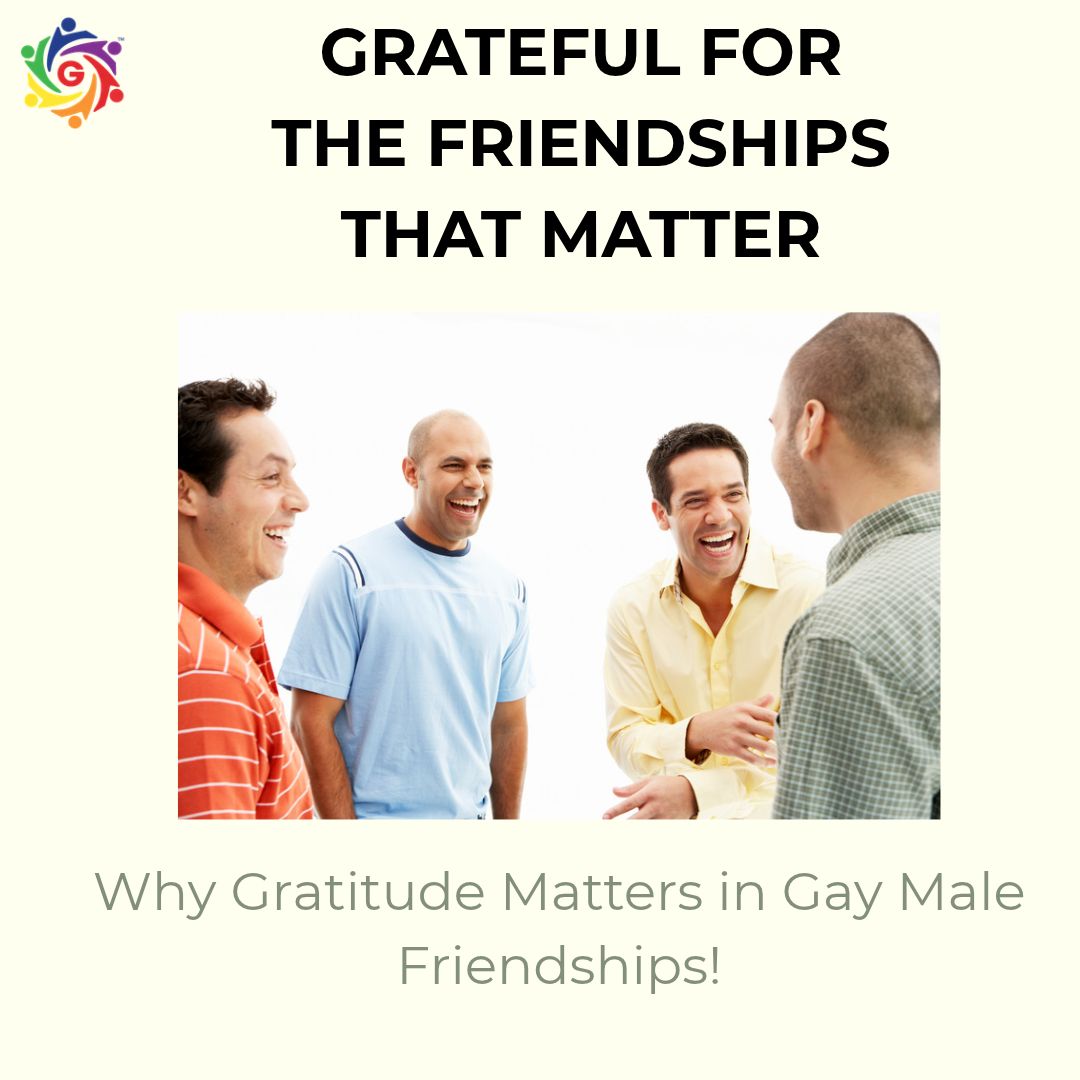
Thanksgiving gives us an obvious reason to talk about gratitude, but friendship gives us a reason to practice it year-round. Think about the people in your life who make ordinary days better: the friend who answers when you call, the person who remembers something you mentioned weeks ago, the guy who invites you even when you have declined the last two invitations, the friend who notices when something seems different, and the acquaintance who is slowly becoming someone you trust.
These relationships can become so familiar that we stop noticing how valuable they are. When a friendship becomes comfortable, appreciation can become silent. We assume our friends know how much we value them, and sometimes they do. Yet there is still value in actually saying it.
For gay men, friendship can play an especially meaningful role in creating belonging, community, shared understanding, and continuity throughout different stages of life. Yet those relationships do not sustain themselves automatically. Building meaningful gay friendships requires participation, reciprocity, respect, communication, and sometimes something as simple as letting another person know that his presence in your life matters.
At Garden State Gay Socials™, our philosophy is Friendship First. Integrity Always.™ Gratitude belongs naturally within that philosophy because appreciation is one way we recognize the people who contribute something meaningful to our lives.
Friendship Is Easy to Notice When It Is Missing
People often recognize the importance of friendship most clearly when they feel disconnected. Perhaps someone moves to a new area. A relationship ends. A longtime friend relocates—a social circle changes. Work becomes consuming. Suddenly the casual interactions that once seemed ordinary are gone.
That absence reveals something important. Friendship is not merely an optional accessory to life. Friends are the people with whom we share stories, meals, jokes, frustrations, celebrations, discoveries, routines, and memories.
Not every friend plays the same role. One person may be the friend you call when something serious happens. Another may be the person you enjoy hiking with. Someone else may share your interest in movies, travel, technology, art, food, sports, history, or local attractions. A healthy social life can contain many different relationships, each meaningful for different reasons.
Gratitude begins by recognizing those differences instead of expecting every friend to satisfy every social need.
Appreciation Does Not Require a Dramatic Gesture
When people hear the word gratitude, they sometimes imagine an emotional speech. That can make appreciation feel awkward, particularly for people who are not naturally expressive.
Gratitude does not need to be dramatic. It can be, "I had a great time tonight." It can be, "Thanks for inviting me." It might be, "I appreciate you checking in," or, "I'm glad we became friends."
These statements don't turn an ordinary friendship into an emotional ceremony. They acknowledge another person's effort or presence.
Small recognition can be particularly meaningful because many positive things people do for one another are easy to overlook. Someone organizes dinner. Someone drives. Someone remembers the reservation. Someone introduces you to another friend. Someone sends you information because he remembered you were interested. Someone checks that you got home safely.
None of these gestures needs applause. Acknowledging them tells the other person that his effort was noticed.
Do Not Save Appreciation for Major Moments
We often express appreciation when something significant happens. A friend helps during a crisis. Someone gives a meaningful gift. A person travels a long distance for an important event. Those moments deserve recognition.
But friendship is mostly built in the moments between the big ones. It is built through ordinary consistency: the text message, the coffee, the repeated invitation, the shared joke, the ride home, the conversation that lasts longer than expected, and the decision to make time.
If we only express gratitude for extraordinary acts, we miss most of what actually makes friendship valuable.
Thanksgiving can therefore serve as a reminder, not a once-a-year obligation. Who made your year better in small ways? Who kept showing up? Who made you feel included? Who made you laugh when you needed it? Who challenged you constructively?
Those are people worth appreciating.
Gratitude and Reciprocity Belong Together
Healthy friendship is not an accounting system. Friends do not need to keep identical records of who called whom, who paid for coffee, or who initiated the last three plans. Life is rarely that symmetrical.
One person may have more time during one period. Another may be dealing with family responsibilities. A friend may temporarily need more support.
But over time, friendship usually needs some sense of reciprocity. Both people need evidence that the relationship matters to the other person.
When that balance disappears for too long, people can begin to wonder why a friendship feels one-sided. Gratitude can help reinforce reciprocity because it prevents another person's effort from becoming invisible or expected.
There is a significant difference between becoming comfortable with someone and taking him for granted.
Appreciate the Friend Who Makes Things Happen
Most social circles have someone who initiates more often. He chooses the restaurant, sends the group message, checks everyone's availability, buys the tickets, suggests the outing, or reminds everyone of the time.
Because he does it consistently, the group can begin treating that work as automatic.
But organizing social experiences requires effort. Even a casual dinner involves decisions and coordination. If one person continually does that work while everyone else shows up, he may eventually stop. Then people wonder why the group no longer gets together.
Gratitude can be practical. Instead of only saying thank you, offer to organize the next outing. Suggest a date. Make the reservation. Invite him somewhere.
Reciprocity becomes more meaningful when appreciation turns into action.
Friendship Does Not Have to Follow One Script
Gay men are not socially identical. Some are outgoing. Some are quiet. Some enjoy large groups. Others prefer conversations with two or three people. Some love nightlife. Others would rather spend Saturday morning hiking. Some enjoy frequent communication. Others can go weeks without talking and resume a conversation comfortably.
Problems can occur when we assume our preferred friendship style is the only legitimate one.
A friend who communicates differently may still care deeply. Someone who dislikes large gatherings may be enthusiastic about dinner. A person who rarely texts may be completely present when you are together.
Appreciation becomes easier when we learn to recognize what another person actually contributes rather than only what we wish he contributed.
That does not mean accepting consistently one-sided relationships. It means distinguishing difference from neglect.
Tell People What You Appreciate Specifically
Specific appreciation often feels more genuine than a general compliment. Instead of saying, "You're a great friend," consider what actually makes him a great friend.
Perhaps he is dependable. Perhaps he is funny. Maybe he makes new people feel welcome. Perhaps he gives thoughtful advice or is willing to tell you when you are wrong. Maybe he has an extraordinary ability to remember details. Perhaps he is the person who actually follows through when everyone else says, "We should get together sometime."
Specific appreciation communicates that you actually see the person.
That can be powerful.
People often hear criticism with remarkable specificity and praise with frustrating vagueness. Friendship allows us to reverse that pattern.
Gratitude Does Not Mean Ignoring Problems
Appreciating someone does not require pretending a friendship is perfect. No relationship is. Friends misunderstand each other. People cancel plans. Someone says the wrong thing. Expectations differ. Communication breaks down.
Gratitude should not become a reason to tolerate disrespect or avoid necessary conversations. In fact, appreciation can make honest conversations easier because the relationship has a foundation broader than the current disagreement.
You can value a friend and still tell him that something bothered you. You can appreciate years of friendship and still establish a boundary. You can be grateful for someone's positive qualities without denying his flaws.
Integrity requires both appreciation and honesty. Friendship without honesty can become superficial, while honesty without care can become unnecessarily harsh.
Strong relationships make room for both.
Remember the People Who Welcomed You
Most people can remember entering a room where they did not know anyone. It might have been a new job, school, neighborhood, organization, event, or social group.
Then somebody made it easier.
Perhaps he introduced himself. He invited you into a conversation. He explained what was happening. He introduced you to someone else. He acknowledged that you were standing there.
These actions can appear insignificant to the person performing them, but they rarely feel insignificant to the newcomer.
One of the best ways to express gratitude for having once been welcomed is to welcome somebody else. At a social gathering, notice the person standing by himself. Introduce yourself. Bring him into the conversation. You do not need to become responsible for his entire evening.
Many of the qualities that make someone easy to talk to begin with ordinary attentiveness: listening, asking sincere questions, remembering details, and noticing when someone needs an opening into a conversation.
Gratitude Can Strengthen New Friendships
We usually associate gratitude with established relationships, but appreciation can also help new friendships develop.
Imagine meeting someone at an event and having an enjoyable conversation. A short message afterward saying it was great meeting him and that you enjoyed the conversation confirms the interaction was mutually enjoyable and creates a natural opening for future communication.
There is no need to overcomplicate it.
Many potentially good friendships fade because both people wait for the other person to initiate. Someone eventually has to make the first move.
That is part of the process involved in starting new friendships as a gay man in New Jersey. An initial introduction matters, but following up and creating another opportunity to interact is what begins turning recognition into familiarity.
Familiar Faces Matter More Than We Sometimes Realize
Not every valuable social relationship needs to become a close friendship immediately.
There is value in recognizing people.
You attend an activity and see somebody you met previously. You remember his name. He remembers yours. You continue a conversation from the last event.
Those seemingly small moments reduce the feeling of entering a room full of strangers.
This is why familiar faces can make social events better. Repeated interaction creates a sense of continuity. Over time, some acquaintances remain acquaintances, while others gradually become friends.
Both outcomes have value because a healthy community includes different levels of connection.
Friendship Is Not a Competition
Comparison can quietly undermine appreciation.
One friend has a larger social circle. Another seems to receive more invitations. Someone posts photos from events you weren't invited to. It becomes easy to focus on what you do not have.
Gratitude redirects attention toward what is actually present.
That does not mean settling for unsatisfying relationships. It means recognizing value without constantly comparing your social life to somebody else's.
Your closest friendship does not become less meaningful because another person has ten close friends. A small social circle is not automatically inferior to a large one.
The relevant question is whether your relationships are healthy, reciprocal, enjoyable, and meaningful to you.
Some Friendships Are Seasonal
Not every friendship lasts forever, and that can be difficult to accept.
Some people are important during a particular period of life. A coworker becomes a close friend while you share the same workplace. A neighbor becomes part of your daily routine. Someone you meet through an activity becomes a regular companion.
Then circumstances change. People relocate. Jobs change. Interests evolve. Relationships begin. Schedules become incompatible.
Sometimes the friendship continues in a different form. Sometimes it gradually fades.
Gratitude helps us recognize that a relationship can be meaningful even if it never becomes permanent. The end of regular contact does not erase the good experiences that came before it.
That perspective can reduce the temptation to define every faded friendship as a failure.
Appreciation Should Never Become Permanent Obligation
Being grateful for what someone once did for you does not mean you owe him unlimited access to your life forever.
A friendship can change.
You can appreciate someone's past support while recognizing that the current relationship no longer works. Gratitude is not debt. Healthy friendship is voluntary. It continues because both people find value in the relationship, not because one person is permanently obligated by history.
This distinction becomes especially important when guilt is used to maintain relationships that have become unhealthy.
You can be thankful and still move forward.
Gratitude Becomes Stronger When It Changes Behavior
It is easy to say we value friendship. The more interesting question is whether our behavior demonstrates it.
Do you make time? Do you follow through? Do you occasionally initiate instead of waiting? Do you listen when a friend is talking rather than waiting for your turn to speak? Do you remember important things? Do you respect boundaries? Do you show up when you said you would?
Gratitude becomes much more powerful when it moves beyond a feeling and influences how we treat people.
A friendship can survive an occasional missed call or canceled plan. Real life happens. But repeated indifference communicates something even when the person insists that the friendship matters.
Appreciation is most credible when words and behavior agree.
Shared Experiences Give Friendship Something to Grow Around
Conversation matters, but friendship does not have to develop through conversation alone.
Doing something together can provide a much more natural foundation.
A meal, creative activity, hike, game, cultural experience, seasonal attraction, or community activity gives people a shared point of reference. That is one reason shared activities can strengthen gay friendships.
The activity does not manufacture compatibility. It simply gives people a reason to spend time together and enough structure for conversation to develop naturally.
Over time, the shared activity may become less important than the friendship that grew around it.
Giving Back Can Be an Expression of Gratitude
Thanksgiving naturally brings attention to giving. Community involvement can be one way to transform gratitude into action.
Someone who feels fortunate may choose to donate. Another person may volunteer. Someone may support a local organization. Another may contribute to a food collection, toy drive, or other community effort.
Giving back does not need to be performed for recognition. The purpose is not to demonstrate generosity. It is to contribute.
Shared charitable activities can also create meaningful social experiences because participants are working toward something beyond themselves. The cause should remain the primary purpose, but community service can simultaneously remind people that connection grows through participation.
Being Included and Belonging Are Not the Same Thing
Being included means someone gives you access to a space.
Belonging feels deeper.
It develops when you believe your presence matters within that space.
Gratitude contributes to belonging because it communicates that people are not interchangeable. "I am glad you came." "Thanks for helping." "It was good seeing you." "We missed you last time."
These are small statements, but they tell people that their presence was noticed.
That distinction is particularly important when thinking about gay social events in New Jersey and genuine community. The value of a gathering is not simply that people occupy the same room. The real opportunity begins when those people recognize, include, remember, and interact with one another.
Do Not Assume People Know They Matter
This may be the simplest lesson of all.
We often assume that a friend knows we appreciate him. We assume he knows we had fun. We assume he knows we are glad the friendship exists.
Maybe he does.
But why leave something positive unsaid?
People cannot reliably infer everything we feel. Friendship benefits from communication just like every other meaningful relationship.
If somebody matters, there is nothing weak or embarrassing about acknowledging it. You do not need to become sentimental if that is not your personality.
Use your own language.
"Thanks for being there this year" may be enough.
Appreciate the People Who Challenge You Constructively
Not every good friend tells us what we want to hear.
Sometimes friendship shows up as respectful disagreement. A friend may notice that you are repeating a pattern that has caused problems before. He may question a decision. He may tell you that something you said was unfair. He may encourage you to reconsider an assumption.
That does not automatically make him negative.
The important distinction is intention and respect.
Constant criticism is not friendship, but thoughtful honesty can be valuable precisely because it comes from someone who knows you and wants good things for you.
A person who respectfully challenges us can sometimes contribute more to our growth than someone who agrees with everything.
Gratitude for Friendships That Have Not Happened Yet
Some of the people who may become important to you are currently strangers.
You have not met them yet.
Perhaps you will meet through work, a mutual friend, travel, a community organization, or an activity you almost decided not to attend.
This is one reason remaining open to new experiences matters.
A social life does not have to be finished.
At any age, people can meet. Acquaintances can become friends. New traditions can develop. Social circles can expand and change.
That does not mean attending every event expecting to find a best friend. That kind of pressure can make socializing less enjoyable. It simply means recognizing that future relationships require opportunities to begin.
Be the Kind of Friend You Hope to Find
It is easy to create a list of qualities we want in other people: dependable, kind, interesting, respectful, honest, thoughtful, fun, supportive.
Gratitude can lead to a more useful question.
Are we offering those qualities ourselves?
If you want friends who initiate, initiate sometimes. If you appreciate people who listen, become a better listener. If reliability matters to you, follow through. If you want to feel welcomed, make somebody else feel welcomed. If you value honesty, communicate honestly without becoming cruel.
The quality of our social lives is influenced not only by the people we meet but also by the person we bring into those relationships.
Create Opportunities for Friendship to Begin
For gay men in New Jersey who want more friendship-centered opportunities, Garden State Gay Socials™ creates organized experiences designed around participation rather than dating.
Activities vary because people vary. Some men enjoy meals. Some prefer creative experiences. Others enjoy recreation, cultural attractions, seasonal activities, hikes, day trips, or simply trying something they have never done before.
The activity gives you a reason to gather. The people provide the possibility of connection.
You can see upcoming Garden State Gay Socials™ events and activities through our permanent events page and choose something that genuinely interests you.
You do not need to know everyone. You do not need to bring a group. You do not need to force a friendship to develop.
Participate, enjoy the experience, have conversations, and allow connection to happen at its own pace.
A Thanksgiving Challenge That Costs Nothing
This Thanksgiving, choose three people who contributed something positive to your year. They do not necessarily need to be your three closest friends.
Send each one a short message and tell him specifically what you appreciated.
Perhaps it is, "Thanks for always including me."
Maybe, "I really appreciated our conversations this year."
Perhaps, "I'm glad we met."
Maybe, "Thank you for checking on me when things were difficult."
Or, "You made me laugh a lot this year."
No elaborate speech. No expectation of anything in return. Just recognition.
Then consider one more question: whose life could you make a little better by being a better friend yourself?
Gratitude is most meaningful when it changes behavior.
Friendship First. Gratitude Included.
Friendship is built through more than shared identity. It grows through compatibility, trust, humor, consistency, mutual effort, communication, respect, and the willingness to keep showing up.
Gratitude cannot manufacture those qualities, but it can help us recognize them. It reminds us not to treat good people as permanent fixtures who require no attention. It encourages us to notice effort and appreciate ordinary moments before they become memories.
Most importantly, gratitude reminds us that friendship is not only about what other people contribute to our lives. It is also about what we contribute to theirs.
This Thanksgiving, appreciate the people who make your world better. Tell somebody. Invite somebody. Thank somebody. Welcome somebody. Remain open to the possibility that some of the friendships you may someday be most grateful for have not even begun yet.
At Garden State Gay Socials™, we will continue creating opportunities for gay men to get together, share experiences, meet face to face, and build friendships at their own pace.
Because meaningful community isn't created by a slogan; it is created when people choose to treat one another with consideration, authenticity, gratitude, and respect.
Garden State Gay Socials™
Friendship First. Integrity Always.™
Leave A Comment
Please login to add a comment!
Comments (0)