Why Gay Men Feel More Comfortable In Small Groups Than Large Events NJ
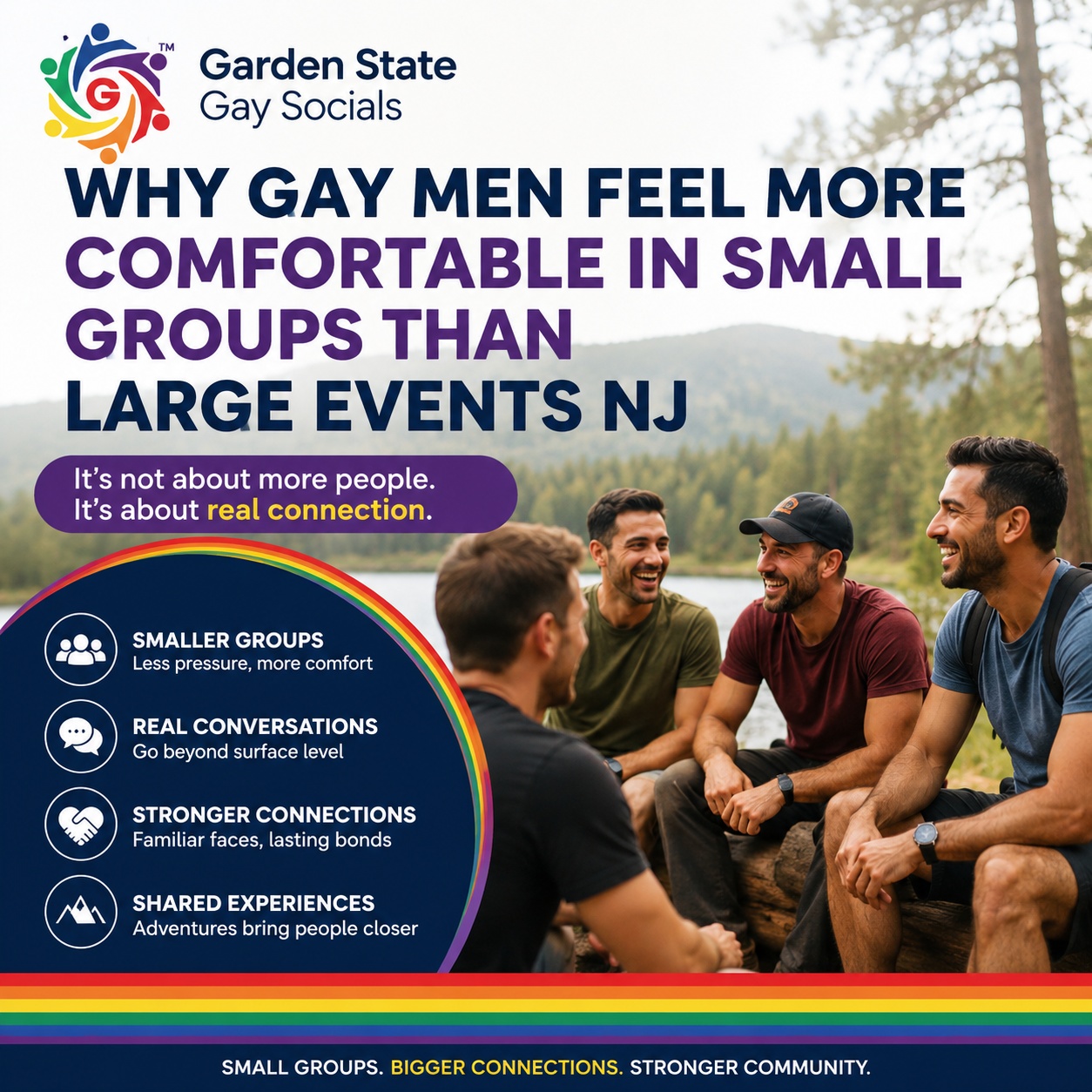
Why Gay Men Feel More Comfortable In Small Groups Than Large Events NJ
If you have ever gone to a large social event and left feeling strangely disconnected despite being surrounded by people, you are not alone.
A lot of gay men in New Jersey experience this, even if they do not always talk about it openly. On paper, large events seem to create more opportunities for connection. More people should mean more chances to meet someone interesting, have a meaningful conversation, or feel socially fulfilled.
In reality, that is often not what happens.
Many people leave large social events feeling overstimulated, overlooked, emotionally exhausted, or frustrated by how surface-level most interactions felt. They may have talked to many people, but very little of it actually stuck with them afterward. Conversations felt brief. Interactions were interrupted. Nothing really developed beyond the moment itself.
At first, it is easy to assume this is simply part of socializing. Some people even begin to believe there is something wrong with them for not enjoying these environments more.
But over time, many begin to realize the issue is not necessarily their personality. It is the structure of the environment itself.
This is one of the biggest reasons smaller gay social groups in NJ have started feeling more appealing to many people. Smaller environments create a very different emotional, social, and psychological experience.
The difference is much bigger than group size alone.
Why Large Events Often Feel Emotionally Draining
Large social events tend to create constant movement.
People rotate rapidly between conversations. Groups form and dissolve quickly. Music, noise, distractions, and shifting energy levels make it difficult for conversations to settle naturally. Even when interactions begin well, they are often interrupted before they have time to develop.
This creates a subtle but important emotional effect.
Instead of feeling grounded in the interaction, people remain socially “on.” They stay aware of the room, other conversations, whether they should move around more, and how they are being perceived.
That constant awareness becomes mentally exhausting.
Many people do not realize how much energy they spend managing social environments until they leave them. They may physically attend for hours without ever relaxing into the experience.
This is especially true in environments where there is pressure to appear confident, outgoing, attractive, or socially successful.
When environments encourage performance over presence, people often stay guarded without realizing it.
That significantly changes the quality of the interaction.
Instead of conversations feeling natural, they become transactional. People exchange surface-level information, move quickly between interactions, and rarely stay present long enough for comfort or familiarity to build.
This creates the illusion of connection without its substance.
Why Smaller Groups Feel Safer Socially
Smaller group environments change the emotional dynamics almost immediately.
When there are fewer people, there is less pressure to constantly reposition yourself socially. Conversations naturally last longer because there are fewer interruptions and fewer competing interactions happening at the same time.
This creates something many people do not realize they are missing until they experience it:
social breathing room.
In smaller groups, people often stop monitoring themselves as heavily. They begin listening more closely, responding more naturally, and relaxing into the interaction instead of trying to manage it.
That shift changes everything.
When people feel psychologically safer, they become more authentic. Humor becomes more natural. Conversations become less rehearsed. Silence feels less uncomfortable. Interactions deepen because there is time to go beyond introductions and surface-level topics.
This is one reason why many people who dislike large events suddenly feel far more comfortable in smaller social environments.
It is not that they dislike socializing.
They dislike environments that never allow them to settle into the interaction.
The Problem With Constant Reset Environments
Another challenge with large events is the constant social reset.
At many large gatherings, interactions happen once and then fade away. You meet someone briefly, have a decent conversation, and then lose them in the crowd. Even if you enjoyed talking with them, the environment often makes continuation difficult.
This creates a cycle of repetition where every interaction starts from zero.
People repeatedly:
introduce themselves,
repeat basic information,
exchange short conversations,
and then move on.
Over time, this becomes emotionally draining because nothing builds.
Smaller recurring environments work differently.
When people see the same individuals more than once, familiarity naturally begins to form. Conversations become easier because there is already some shared context. There is less pressure to create immediate chemistry because the interaction does not need to carry everything at once.
This is one of the biggest advantages of ongoing small group experiences.
Connection develops gradually instead of needing to happen instantly.
That difference reduces anxiety significantly.
Why Many Gay Men Are Looking For More Intentional Environments
A growing number of people are realizing they are not actually seeking more social exposure. They are looking for more meaningful social experiences.
That distinction matters.
Many traditional social environments prioritize volume, stimulation, and activity. They are built around energy and movement rather than continuity and comfort. While some people enjoy that atmosphere, others eventually begin searching for something different.
They want environments where:
conversation feels easier,
people seem more approachable,
showing up alone does not feel intimidating,
and interactions have room to continue naturally.
This is why intentional gay social groups in NJ are resonating more strongly with people looking for genuine connection.
The focus shifts from maximizing attention to improving interaction quality.
That creates a much different emotional experience.
Why Familiarity Changes Everything
Familiarity is one of the most overlooked factors in human connection.
Most people underestimate how important repeated exposure is for comfort, trust, and relationship-building. In large one-time environments, familiarity rarely has time to develop. Every interaction feels isolated.
Smaller recurring groups naturally create repetition.
You begin seeing the same faces.
You remember previous conversations.
You recognize personalities.
You become more comfortable socially.
Over time, this creates continuity.
That continuity dramatically reduces social pressure because interactions no longer feel like first impressions every single time.
People begin relaxing into the environment rather than trying to “win” the interaction immediately.
This is often the point at which real friendships and meaningful connections begin to form.
Why Smaller Groups Reduce Social Performance Pressure
Large social settings often encourage performance behavior.
People become highly aware of:
how they look,
how they sound,
whether they appear interesting,
whether they are talking enough,
or whether they are standing out socially.
This happens subtly, but it shapes interaction quality in major ways.
In environments where there is pressure to attract attention or make an instant impression quickly, conversations tend to stay shallow. People focus more on managing perception than on simply being present.
Smaller groups reduce this pressure significantly.
Because interactions move more slowly and there is less competition for attention, people stop trying so hard to perform socially. They become more grounded and conversational.
This changes how interactions feel emotionally.
Instead of trying to impress, people begin relating.
That difference is often what makes smaller social experiences feel more memorable and emotionally satisfying.
The Role Shared Experiences Play In Connection
Shared experiences create a natural conversational structure.
When people participate in something together, whether it is a hike, a day trip, a breakfast gathering, or a structured outing, interaction becomes easier because the environment itself supports conversation.
People are no longer forced to generate connections from nothing.
There is already a shared context:
the environment,
the activity,
the experience itself.
This makes interaction feel more organic and less forced.
Smaller groups enhance this effect because participants remain together longer. Instead of conversations constantly being broken apart, they can continue naturally throughout the shared experience.
This creates stronger memory associations and greater emotional continuity.
Over time, repeated shared experiences build familiarity much faster than isolated one-time conversations ever could.
Why Smaller Groups Often Feel More Emotionally Balanced
Large social environments can become emotionally unpredictable.
The energy shifts constantly. Conversations begin and end rapidly. Group dynamics change quickly. Some people feel energized by this, but many eventually find it exhausting.
Smaller groups tend to feel more emotionally stable.
The pacing slows down.
People become easier to read.
Conversations last longer.
Interactions feel more complete.
This creates emotional consistency.
That consistency helps people relax because they no longer feel they need to constantly adjust socially to their surroundings.
As comfort increases, authenticity increases.
That is where deeper interaction usually begins.
Why Real Connection Usually Develops Slowly
One of the biggest misconceptions about connection is the belief that meaningful relationships happen instantly.
Sometimes strong chemistry develops immediately, but most lasting connections actually develop through repeated, low-pressure interactions over time.
Smaller, recurring social environments naturally support this.
People:
meet,
talk,
see each other again,
continue conversations,
share experiences,
and slowly build familiarity.
This process feels much more sustainable emotionally because there is less pressure for every interaction to become significant immediately.
Over time, small interactions accumulate into something meaningful.
That is how many genuine friendships and relationships actually form.
Not through one perfect interaction,
but through consistency and gradual comfort.
Why Intentional Social Design Matters
Not all social environments are structured equally.
Some environments are intentionally designed to maximize energy, attendance, and stimulation. Others are intentionally designed to support comfort, familiarity, and interaction quality.
That distinction shapes the outcome.
When environments are built around continuity and smaller group dynamics, people tend to feel:
safer,
less pressured,
more socially relaxed,
and more willing to participate authentically.
This changes not only how interactions begin, but whether they continue afterward.
Many people assume social success depends entirely on personality or confidence. In reality, the environment often plays a much larger role than they realize.
The same person can struggle in one environment and thrive in another simply because the structure supports different types of interaction.
Why More People Are Moving Toward Smaller Gay Social Groups In NJ
As more people become frustrated with superficial or repetitive social experiences, smaller intentional communities are becoming more appealing.
People increasingly want:
quality over quantity,
familiarity over randomness,
and meaningful interaction over endless introductions.
This does not mean large events are inherently bad.
It simply means different environments serve different emotional and social needs.
For many people seeking real connection, smaller recurring environments often align more naturally with what they are actually looking for.
This is especially true for people who:
feel socially overwhelmed in large settings,
prefer more relaxed conversation,
want ongoing familiarity,
or are tired of environments that constantly reset?
Why Comfort Leads To Better Conversations
Comfort is one of the strongest predictors of interaction quality.
When people feel relaxed, they:
listen better,
respond more naturally,
share more openly,
and remain emotionally present.
When people feel pressured, distracted, or overstimulated, conversations tend to stay shallow.
This is one reason why smaller groups often produce stronger interactions.
The environment itself lowers tension.
People no longer feel they need to maximize every social moment. They become more willing to experience the interaction rather than try to control it.
That creates better conversations naturally.
Why Smaller Does Not Mean Less Valuable
Many people mistakenly assume that larger environments automatically create more opportunities because more people are present.
But more people do not always mean more connections.
In many cases, fewer people with better interaction quality create far more meaningful outcomes.
Smaller groups allow:
longer conversations,
greater familiarity,
reduced pressure,
and stronger continuity.
Over time, those factors become much more valuable than sheer volume.
This is why many people eventually realize they would rather attend one meaningful, smaller gathering than multiple large events that leave them feeling emotionally disconnected afterward.
The Shift From Exposure To Experience
At some point, many people stop focusing on maximizing exposure and start focusing on improving the quality of the experience itself.
That shift changes everything.
Instead of asking:
“How many people will be there?”
They begin asking:
“Will this environment actually allow connection to happen?”
That question leads to very different choices.
Smaller, intentionally formed social groups often answer that question more effectively because they are structured around interaction quality rather than social overload.
This creates experiences that feel calmer, more approachable, and more emotionally sustainable over time.
Final Thoughts
The reason many gay men feel more comfortable in smaller groups than large events is not simply about introversion or personality.
It is about how environments shape human interaction.
Large events often create:
constant movement,
social pressure,
interrupted conversations,
and emotional overstimulation.
Smaller groups create:
continuity,
comfort,
familiarity,
and space for conversations to develop naturally.
That difference affects how people feel during the interaction and whether the interaction continues afterward.
Over time, many people realize they are not actually looking for bigger social experiences.
They are looking for environments where they can finally relax enough to connect.
And when the environment supports that,
Everything begins to change.
Leave A Comment
Please login to add a comment!
Comments (0)